
Al-Razi
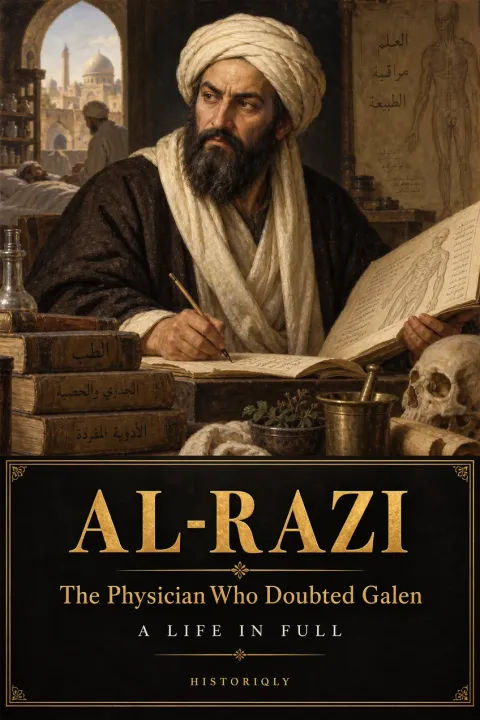
The Physician Who Doubted Galen
Get the full EPUB
Drop your email and the EPUB downloads straight to your device. We'll also ping you when the next chronicle lands — unsubscribe any time.
Your email is already on file — enjoy the read.
Download the EPUBIn the year 910 CE, somewhere in the Persian city of Rayy, a physician sat down to write a short treatise that would be reprinted across Europe forty times over the next four centuries. Abu Bakr Muhammad ibn Zakariya al-Razi — known to medieval European doctors simply as Rhazes — was describing something no physician before him had ever attempted: a precise clinical distinction between two plagues that had blended together in the literature of medicine for a thousand years. Smallpox was not measles. Measles was not smallpox. The signs were different. The progression was different. The danger was different. In setting that down in ink, al-Razi became the first person in recorded history to practice what we would now call evidence-based medicine — and he was only getting started.
“It grieves me to oppose and criticize the man Galen from whose sea of knowledge I have drawn much.”
c. 864–925
Born in Rayy, Persia — a prosperous ancient city on the southern slopes of the Elburz Range, near present-day Tehran — al-Razi spent his early decades as a musician and alchemist before turning to medicine, reportedly after age thirty. He died in Rayy after a life of unceasing scholarship, nearly blind, having written some two hundred works that shaped medicine on three continents.
~200
Al-Razi wrote approximately two hundred books and treatises spanning medicine, alchemy, philosophy, mathematics, and astronomy. His magnum opus, the <em>Kitab al-Hawi</em> (Comprehensive Book on Medicine), ran to twenty-three volumes and has been described as possibly the largest medical work ever composed by a single author.
40
His treatise on smallpox and measles — the first clinical distinction between the two diseases in medical history — was printed in forty editions between 1498 and 1866. It remained the standard European reference on the subject for nearly four hundred years after its first Latin translation in 1565.
368
Al-Razi's smallpox and measles treatise was first printed in Venice in 1498 and last reprinted in 1866 — a span of 368 years across forty editions. No other medical text from the medieval Islamic world remained continuously in print in European editions for as long. His <em>Kitab al-Mansuri</em>, separately, was still being actively taught in medical schools in the seventeenth century, over 700 years after he wrote it.
First clinical distinction of smallpox from measles, empirical medicine, alchemy, critique of Galen's humoral theory
Defining Events
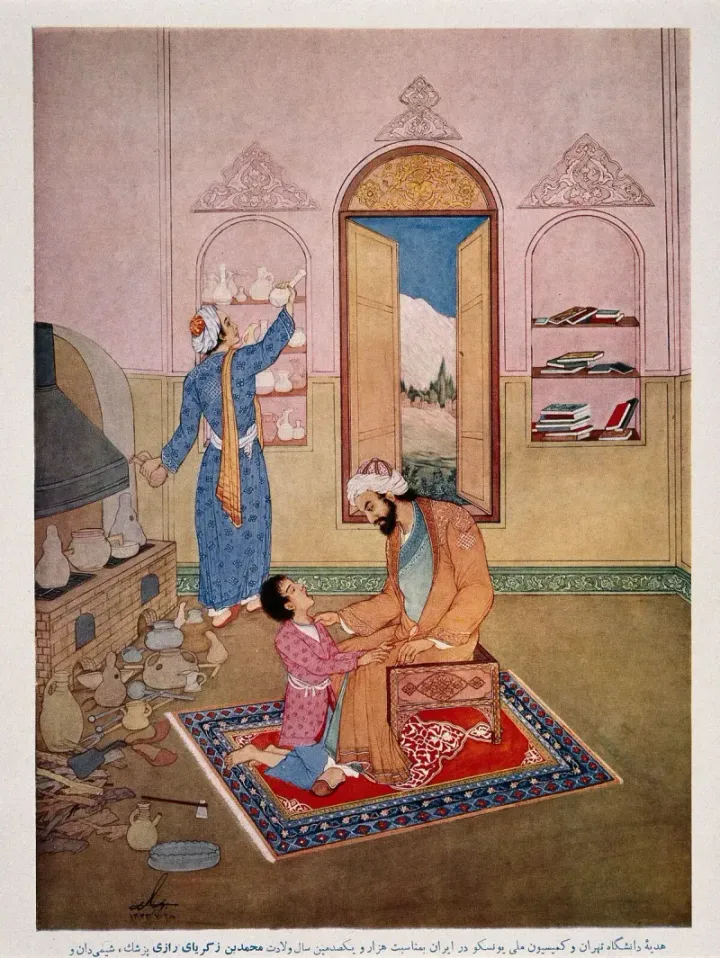
Smallpox and Measles — The First Distinction
In his Kitab al-Judari wa al-Hasbah (Book on Smallpox and Measles), al-Razi became the first physician in recorded history to distinguish the two diseases as clinically separate conditions. He described the differential signs with precision: smallpox arrives with back pain, shivering, and slow pustule formation; measles brings itching, inflammation of the nose, and a faster-spreading rash. Before al-Razi, the two diseases had been conflated for a millennium. His slim treatise was translated into Latin in 1565 and went through forty European printings — remaining the standard reference on the subject until the age of vaccination.
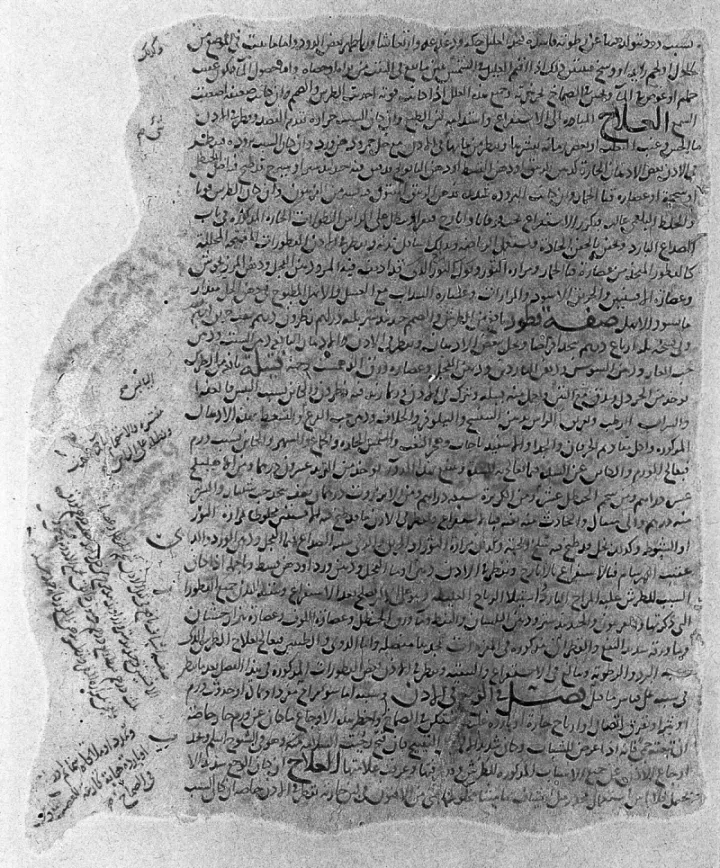
The Comprehensive Book — Al-Hawi
The Kitab al-Hawi fi al-Tibb — translated into Latin as the Continens Liber — was the largest medical encyclopedia composed by any single author in the ancient or medieval world. Spanning twenty-three volumes, it drew on Greek, Syriac, Arabic, and Indian sources alongside al-Razi's own decades of clinical observation and case notes. He never completed it in final form; his students compiled and published it after his death. Translated by the Sicilian-Jewish physician Faraj ben Salim for Charles of Anjou in 1279, the Continens became one of the most prized and expensive medical books in medieval Europe.
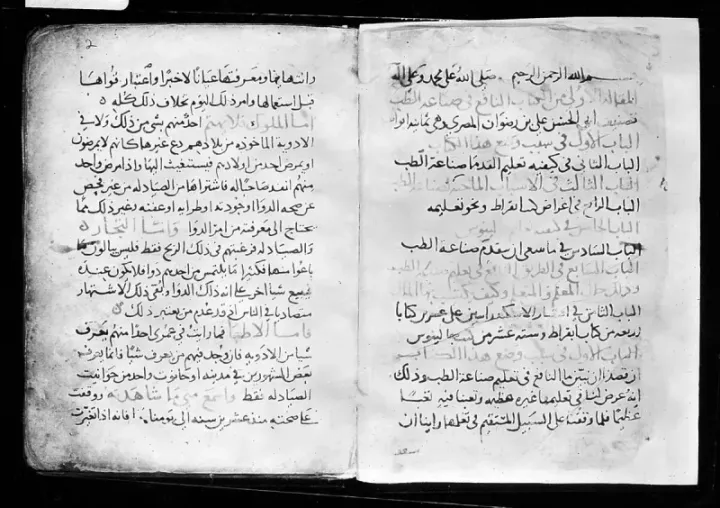
Doubts About Galen
In his Shukuk 'ala Jalinunus (Doubts About Galen), al-Razi committed the most intellectually courageous act in medieval medicine: he systematically challenged the greatest medical authority of the ancient world. Using his own clinical observations to contradict Galen's humoral theory and descriptions of fever, he acknowledged the debt — 'It grieves me to oppose the man from whose sea of knowledge I have drawn much' — before proceeding to expose the errors. It was the first sustained, empirical critique of Galenic medicine in history, and it pointed the way toward the scientific revolution that would come six centuries later.
Timeline
Born in Rayy
Born in Rayy (ancient Rhagae), a prosperous city on the southern slopes of the Elburz Range in Persia, near present-day Tehran. Rayy was one of the great cities of the eastern Islamic world — cosmopolitan, prosperous, and situated on major trade routes. His surname al-Razi simply means 'from Rayy.'
Musician and Alchemist
Before medicine, al-Razi was known as a lute player and alchemist. He spent years in the alchemical laboratory, experimenting with distillation, sublimation, and chemical transformation. It is possible that eye irritation from alchemical fumes sparked his interest in ophthalmology and, eventually, in medicine more broadly. He came to formal medical study late — reportedly after the age of thirty.
Medical Studies in Baghdad
Travelled to Baghdad — the intellectual capital of the Abbasid Caliphate — to study medicine under 'Ali ibn Sahl Rabban al-Tabari, author of the Firdaws al-Hikma (Paradise of Wisdom), one of the first comprehensive medical encyclopedias in Arabic. Baghdad's House of Wisdom (Bayt al-Hikma) was at the height of its influence, with Greek, Persian, and Indian texts being translated and synthesised at an extraordinary rate.
Returns to Rayy, Builds His Reputation
Returned to Rayy and established himself as a practising physician and teacher. His clinical reputation grew rapidly. He organised his teaching in concentric circles — questions passed from student to student, reaching al-Razi only when all circles had failed to answer. He treated poor patients free of charge throughout his career.
Director of the Hospital at Rayy
Appointed director of the hospital at Rayy by the city's governor, Mansur ibn Ishaq ibn Ahmad ibn Asad. It was to Mansur that al-Razi dedicated his most accessible work, the ten-chapter Kitab al-Mansuri — a comprehensive medical textbook that would be taught in European universities for seven centuries. The hospital was organised around al-Razi's own methods: concentric teaching circles, meticulous case records, and care for the poor without charge.
Chief Physician at the Muqtadari Hospital, Baghdad
Called to Baghdad to serve as head physician of the great Muqtadari Hospital under Caliph al-Muktafi. According to legend, al-Razi selected the hospital's site by hanging strips of meat at candidate locations across the city and building where the meat took longest to decay — reasoning it indicated the cleanest air. The Baghdad hospital treated patients free of charge, kept detailed records, and separated wards by disease type.
Smallpox and Measles Distinguished
Composed the Kitab al-Judari wa al-Hasbah, the first systematic clinical differentiation of smallpox and measles in medical history. The short treatise precisely described the differential onset, rash progression, and severity of each disease. Translated into Latin in 1565, it went through forty European editions — remaining the standard reference until the 19th century.
The Comprehensive Book — Al-Hawi
Spent decades assembling the Kitab al-Hawi fi al-Tibb — a twenty-three-volume compendium of all medical knowledge from Greek, Syriac, Arabic, and Indian traditions, supplemented by his own clinical notes. He never completed it to his satisfaction; his students compiled and published it after his death. Translated by Faraj ben Salim for Charles of Anjou in 1279, the Latin Continens Liber became one of the most expensive books in medieval Europe.
Doubts About Galen
Wrote Shukuk 'ala Jalinunus — the first systematic empirical challenge to Galen's medical authority in history. Al-Razi used his own clinical observations to contradict Galenic humoral theory, particularly regarding fever. He prefaced his critique with a statement of genuine admiration: 'It grieves me to oppose the man from whose sea of knowledge I have drawn much' — before proceeding to show where observation contradicted doctrine.
Progressive Blindness
In old age al-Razi suffered progressive vision loss, likely cataracts — possibly accelerated by decades of close laboratory work. When a physician offered to operate on his eyes, he reportedly declined: 'I have seen enough of the world.' Despite near-blindness, he continued to compose and dictate with the help of students and scribes, writing: 'My hand became paralyzed… yet I have never given up, but kept on reading and writing with the help of others.'
Death in Rayy
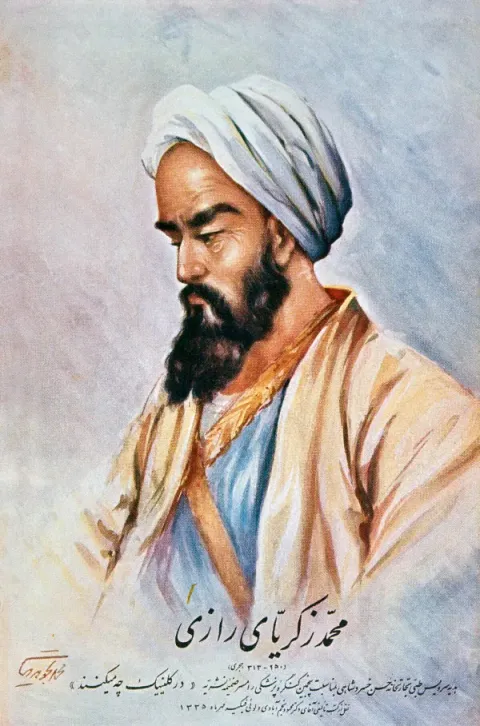
Died in Rayy, the city of his birth, after a life of relentless scholarship. His student and biographer Ibn Abi Usaybi'a recorded that he left behind approximately two hundred works spanning medicine, alchemy, philosophy, mathematics, and music. His portrait was hung in the Faculty of Medicine at the University of Paris — where it remains to this day.
Key Figures
Mansur ibn Ishaq
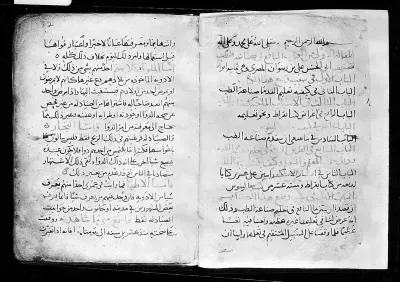
Governor of Rayy and al-Razi's principal patron, to whom the physician dedicated his most famous textbook — the ten-chapter Kitab al-Mansuri (c. 903 CE). It was Mansur who appointed al-Razi director of the Rayy hospital, giving him the institutional base from which to conduct his decades of systematic clinical observation. The governor's patronage was both practical and intellectual: he supported al-Razi's work at a time when experimental medicine was still viewed with suspicion, and the dedication of the Mansuri secured the book's prestige across the Islamic world. The ninth chapter of the Mansuri — a clinical treatise on internal medicine — later circulated independently in Europe and was annotated by some of the greatest Renaissance physicians, including the young Andreas Vesalius.
Galen of Pergamon
The second-century Greek physician whose humoral theory dominated medicine for over a thousand years — and whom al-Razi dared to contradict. Galen was not a rival al-Razi ever met; he was a ghost that haunted every medical school in the medieval world, his texts treated as near-scripture. Al-Razi's Shukuk 'ala Jalinunus was the first sustained empirical challenge to Galenic authority in history. It required extraordinary intellectual courage to publish: al-Razi acknowledged Galen's genius explicitly — 'from whose sea of knowledge I have drawn much' — while systematically demonstrating, case by case, where clinical observation contradicted Galenic doctrine. His critique of Galen's description of fever was particularly precise and devastating, anticipating by centuries the kind of evidence-based medicine that would not become standard until the nineteenth century.
The Legacy of Al-Razi
Al-Razi accomplished something rare in any age: he looked at the received wisdom of a thousand years, ran it against what he had actually seen at the bedside, and wrote down the discrepancies. The authority of Galen was enormous — it took extraordinary courage to write Doubts About Galen in a world that treated the ancient physician's texts as near-infallible. Al-Razi did it anyway, and did it with scrupulous fairness, acknowledging his debt before making his argument.
His smallpox treatise remained the standard European reference on the disease for nearly four centuries. His Kitab al-Hawi was so vast and so comprehensive that medieval European universities had to pool resources to afford a copy. His alchemical work — distilling alcohol, isolating sulfuric acid, classifying chemical substances — planted the seeds of modern chemistry. He treated the poor without charge, organised hospitals with systematic wards, and selected hospital sites by empirical test rather than tradition.
At the end of his life, nearly blind, he continued to dictate and compose. He had seen enough of the world to fill two hundred books. Read his story in his own words in the first-person ePub.
Get the Full Book
Read the story of Al-Razi — 8 chapters of historical narrative.
Dramatised first-person narrative; not an autobiography.