
Emmanuel Levinas
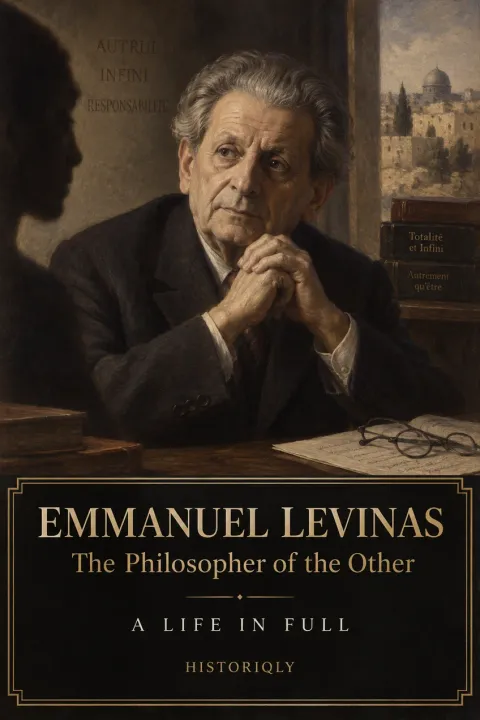
The Philosopher of the Other
Get the full EPUB
Drop your email and the EPUB downloads straight to your device. We'll also ping you when the next chronicle lands — unsubscribe any time.
Your email is already on file — enjoy the read.
Download the EPUBEmmanuel Levinas was born into a Jewish family in Kaunas, Lithuania, in 1906, and spent the rest of his life asking a single question: what do we owe to another human being? He studied under Husserl and Heidegger in Freiburg, survived five years as a prisoner of war in Nazi Germany, lost nearly his entire family to the Holocaust, and emerged from that catastrophe with a philosophy that placed the encounter with another person — the Face — at the foundation of all ethics. In a century that produced industrialised murder, Levinas insisted that responsibility for the Other is the first fact of human existence, not an afterthought.
“The face says to me: Do not kill me.”
1906–1995
Born in Kaunas, Lithuania, into a cultivated Jewish family. Died in Paris on Christmas Day, 1995, having reshaped the landscape of Continental philosophy. Eighty-nine years that spanned two world wars, the Holocaust, and the reconstruction of European thought.
5
From 1940 to 1945, Levinas was held as a prisoner of war in Stalag XI-B near Fallingbostel, Germany. His status as a French soldier — not a civilian Jew — saved his life. His French military uniform was a thin shield against the gas chambers.
2
Totality and Infinity (1961) and Otherwise than Being (1974) — two monumental works that overturned the primacy of ontology in Western philosophy and placed ethics, the infinite demand of the Other's face, at the centre of all thought.
6+
His parents, two brothers, and his in-laws were murdered by the Nazis during the Holocaust. His wife and daughter survived only because they were hidden in a French monastery. The dedication of Otherwise than Being reads: 'To the memory of those who were closest.'
Philosopher, phenomenologist, ethicist, Talmudic scholar
Defining Events
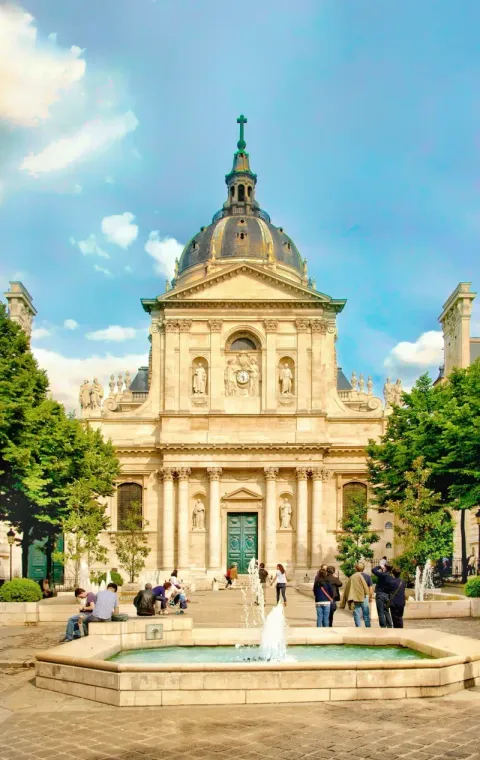
Totality and Infinity
Levinas's first major philosophical work, submitted as his Doctorat d'Etat at the Sorbonne, struck Continental philosophy like a detonation. In it, he argued that Western thought had been captive to 'totality' — the attempt to reduce everything, including other people, to systems of knowledge and power. Against this, he placed 'infinity' — the irreducible strangeness of another person's face, which cannot be possessed or comprehended but only welcomed. The book recast the relationship between self and other as the foundation of ethics, prior to ontology, prior to politics, prior to everything. Jacques Derrida called it one of the great works of the twentieth century.
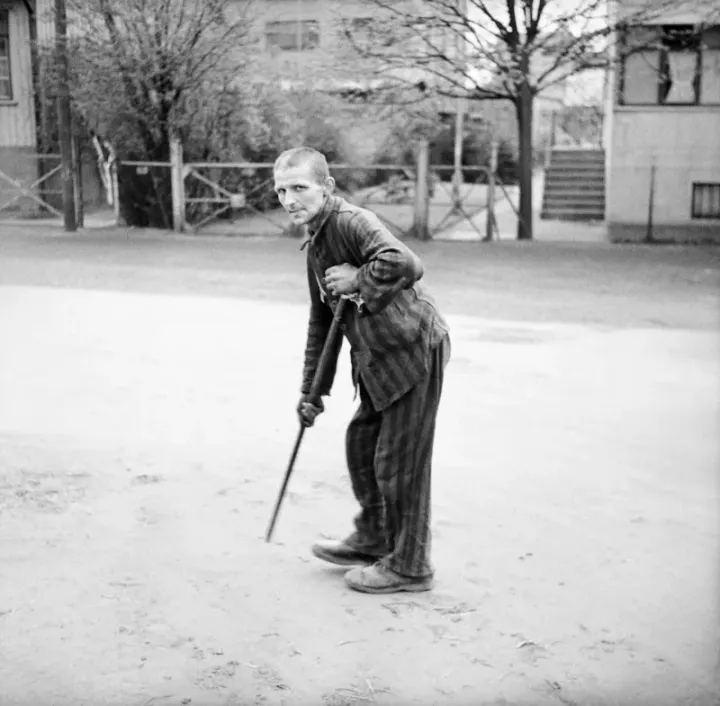
Prisoner 1492
Mobilised as a French army interpreter in 1939, Levinas was captured during the fall of France and spent five years in Stalag XI-B near Fallingbostel. As a Jewish prisoner of war, he lived in constant danger — but his French military uniform afforded him protection under the Geneva Convention that civilian Jews did not receive. He was assigned to a forced labour commando of Jewish prisoners, felling trees in the forest. In the barracks at night, he read and wrote philosophy. Meanwhile, back in Lithuania, the Nazis and their collaborators were murdering his parents, his brothers, and his in-laws. He learned of their deaths only after liberation.
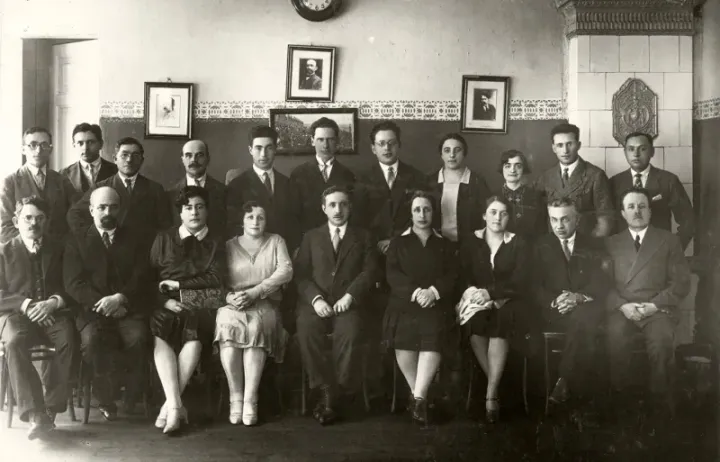
The Talmudic Turn
After the war, Levinas encountered the enigmatic Talmudic master known only as Monsieur Chouchani — a wandering, dishevelled genius whose real name remains disputed to this day. Chouchani's electrifying method of reading Talmud transformed Levinas's understanding of Jewish textual tradition and opened a second, parallel track in his work. Beginning in 1960, Levinas delivered annual Talmudic lectures at the Colloquium of French Jewish Intellectuals that became legendary — rigorous, philosophical readings of ancient rabbinic texts that showed how Jewish thought and Western philosophy could illuminate each other without collapsing into one.
Timeline
Born in Kaunas
Born on January 12 into a middle-class Jewish family in Kaunas, Lithuania. His father owned a bookshop. The household was steeped in Russian literature — Pushkin, Dostoevsky, Tolstoy — and the Hebrew Bible. Both traditions would shape his thought for the rest of his life.
Arrived in Strasbourg
Left Lithuania for the University of Strasbourg, where he studied philosophy. Here he first encountered the phenomenology of Edmund Husserl and the work that would redirect his entire intellectual life. Strasbourg also gave him lifelong friendships with Maurice Blanchot, the novelist and theorist, who would later help hide his wife and daughter during the war.
Freiburg: Husserl and Heidegger
Travelled to Freiburg to study under Husserl himself, arriving just as Heidegger was succeeding Husserl in the chair of philosophy. Levinas attended Heidegger's lectures on Being and Time and was profoundly impressed — and profoundly troubled. Heidegger's subsequent embrace of Nazism in 1933 became the wound that Levinas's entire philosophy would address: how could the greatest thinker of the age fail so catastrophically in ethics?
The Theory of Intuition in Husserl's Phenomenology
Published his doctoral thesis, the first major study of Husserl in French. The book introduced phenomenology to the French-speaking world and directly influenced Sartre, de Beauvoir, and Merleau-Ponty. Levinas was twenty-four years old. He had effectively delivered an entire philosophical tradition to France.
Captured at the Fall of France
Serving as a Russian and German interpreter for the French army, Levinas was captured during the German invasion. He spent the next five years as a prisoner of war in Stalag XI-B. His wife Raissa and daughter Simone survived in hiding, sheltered in a monastery near Orleans, arranged by Maurice Blanchot.
Existence and Existents
Published his first post-war philosophical work, written largely during his captivity. In it, he began his break from Heidegger by arguing that the fundamental experience is not the question of Being but the encounter with existence itself — the horror of the il y a, the anonymous 'there is' that rumbles beneath all things. The ethical turn was underway.
Totality and Infinity
His masterwork, presented as his state doctoral thesis at the Sorbonne. The book argued that the face of the Other makes an ethical demand that precedes all philosophy, all politics, all systems of thought. It was a direct challenge to the totalising ambitions of Western metaphysics from Parmenides to Heidegger. The work established Levinas as one of the most original thinkers in post-war Europe.
Death in Paris
Died on December 25 in Paris at the age of eighty-nine. By then, his influence had spread far beyond philosophy — into theology, political theory, literary criticism, and human rights discourse. Jacques Derrida delivered the eulogy, later published as Adieu to Emmanuel Levinas. His grave in the Pantin cemetery bears no epitaph. The face needs no inscription.
Key Figures
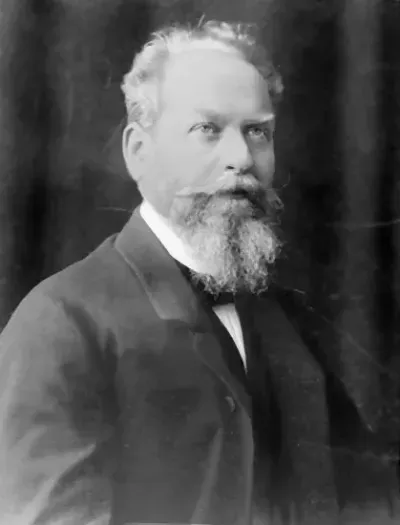
Edmund Husserl
The founder of phenomenology and Levinas's teacher in Freiburg. Husserl's method — returning 'to the things themselves,' stripping away assumptions to describe experience as it is actually lived — gave Levinas the philosophical tools he would use for the rest of his career. Levinas introduced Husserl's thought to France, and through that introduction changed the course of French philosophy. But Levinas would go further than Husserl ever imagined: where Husserl sought the structures of consciousness, Levinas found the face of another person looking back — a face that no structure of consciousness can contain.
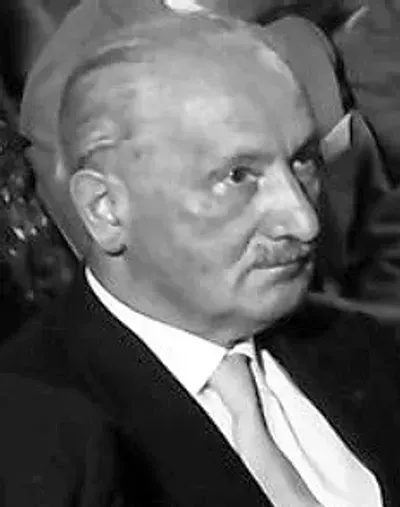
Martin Heidegger
The author of Being and Time and the most influential philosopher of the twentieth century — and a man who joined the Nazi party in 1933, served as rector of Freiburg under the regime, and never adequately repudiated his involvement. Levinas had sat in Heidegger's lecture hall and recognised his genius. But Heidegger's moral catastrophe became the engine of Levinas's entire project: if the question of Being could coexist with complicity in genocide, then something was fundamentally wrong with ontology as first philosophy. Ethics, not Being, had to come first. Levinas spent his life building the alternative.
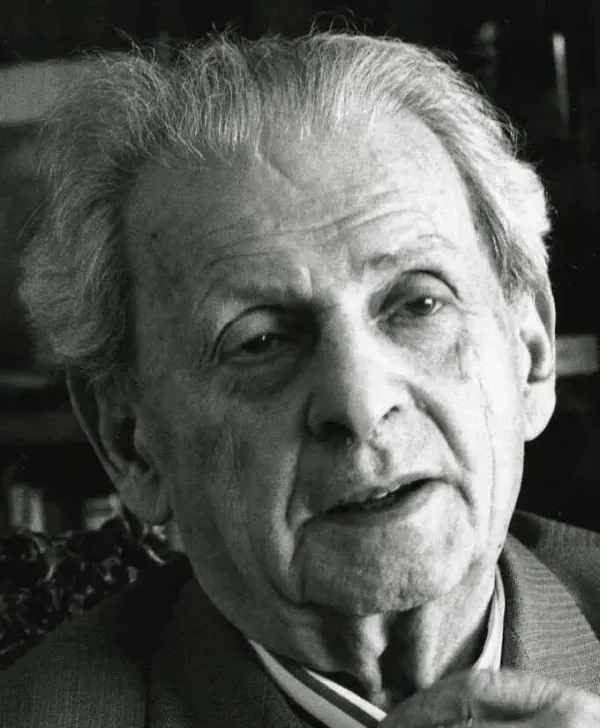
The Legacy of Emmanuel Levinas
Levinas's philosophy emerged from the darkest century in European history and offered something that no other post-war thinker quite managed: not despair, not irony, not deconstruction for its own sake, but an insistence that the encounter with another human face is the origin of all meaning. Before we think, before we know, before we act — we are responsible. The Other's vulnerability is not a problem to be solved but the condition that makes us human.
His influence now stretches across philosophy, theology, human rights law, and literary theory. Derrida, Ricoeur, Judith Butler, and Pope Francis have all drawn from his work. In an age of algorithms and abstraction, his central claim remains stubbornly, irreducibly personal: ethics begins when you look into a face that is not your own. Read his story in his own words — the first-person ePub brings you inside Levinas's mind.
Get the Full Book
Read the story of Emmanuel Levinas — 8 chapters of historical narrative.
Dramatised first-person narrative; not an autobiography.