
Zhu Xi
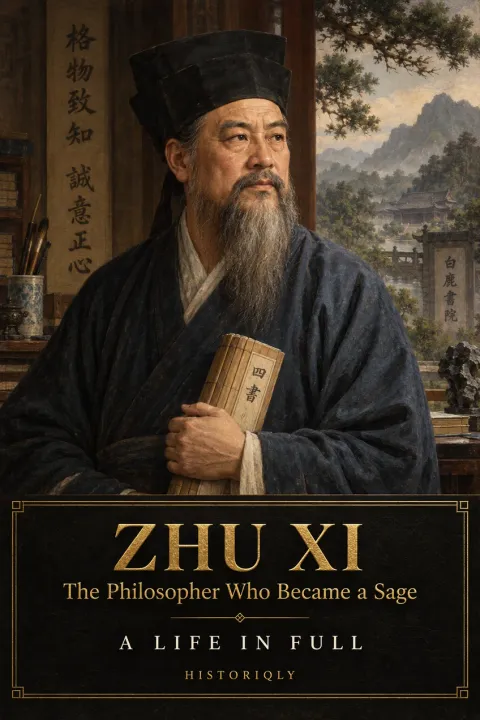
The Philosopher Who Became a Sage
Get the full EPUB
Drop your email and the EPUB downloads straight to your device. We'll also ping you when the next chronicle lands — unsubscribe any time.
Your email is already on file — enjoy the read.
Download the EPUBOn October 18, 1130, Zhu Xi was born in Youxi County, Fujian Province, during the Southern Song dynasty — a dynasty that had lost northern China to the Jurchen Jin and retreated south of the Yangtze River. Against this backdrop of territorial contraction and cultural anxiety, Zhu Xi constructed the most comprehensive and enduring synthesis of Confucian philosophy ever attempted. He reformulated the fundamental questions of human nature, moral cultivation, and cosmic order in terms that would shape the intellectual life of China, Korea, Japan, and Vietnam for seven hundred years. He did this not as a triumphant insider but as a scholar who was repeatedly sidelined by court politics, condemned as a heretic in the final years of his life, and died in disgrace — only to be recognised as one of the greatest sages in the Confucian tradition within a generation of his death.
“Humaneness is the character of the mind and the principle of love.”
1130–1200
Born October 18, 1130, in Youxi County, Fujian Province, Southern Song dynasty China. Died April 23, 1200, at his home in Jianyang, Fujian, aged sixty-nine, in political disgrace under the Qingyuan Proscription. Within forty years of his death, his tablet was installed in the Confucian Temple alongside those of Confucius and Mencius — the highest posthumous honour in the Confucian world.
~700
From the Yuan dynasty's adoption of his Four Books commentaries as the standard civil service examination text in 1313 through the abolition of the examinations in 1905, Zhu Xi's interpretations of the Confucian canon were legally binding for every examination candidate in China — nearly six hundred years. Including his influence on Korea, Japan, and Vietnam, his intellectual dominance spanned roughly seven centuries.
100+ vols
Zhu Xi's collected works fill more than one hundred volumes, including the Sishu Jizhu (commentaries on the Four Books), the Zhuzi Yulei (140 volumes of recorded conversations compiled posthumously), the Jinsilu (compiled with Lu Zuqian), and major commentaries on the Book of Changes, the Book of Odes, and the Book of Documents. He is one of the most prolific philosophical writers in Chinese history.
1175
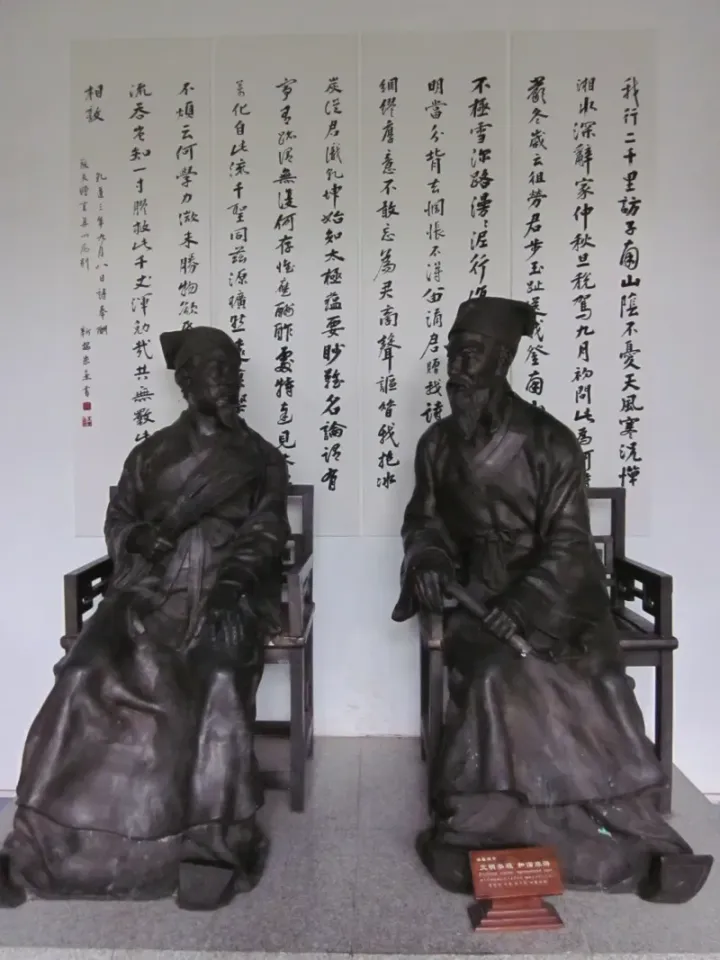
In the summer of 1175, Zhu Xi met his great philosophical rival Lu Jiuyuan (Lu Xiangshan) at Goose Lake Temple in Jiangxi, in one of the most celebrated intellectual encounters in Chinese history. The two men argued over the proper path to sagehood — systematic external investigation versus direct inner recognition — and reached no agreement. The debate founded two rival traditions that defined Neo-Confucian thought for centuries.
Neo-Confucian synthesis, the Four Books, White Deer Grotto Academy, the doctrine of li and qi
Defining Events
The Four Books Commentary
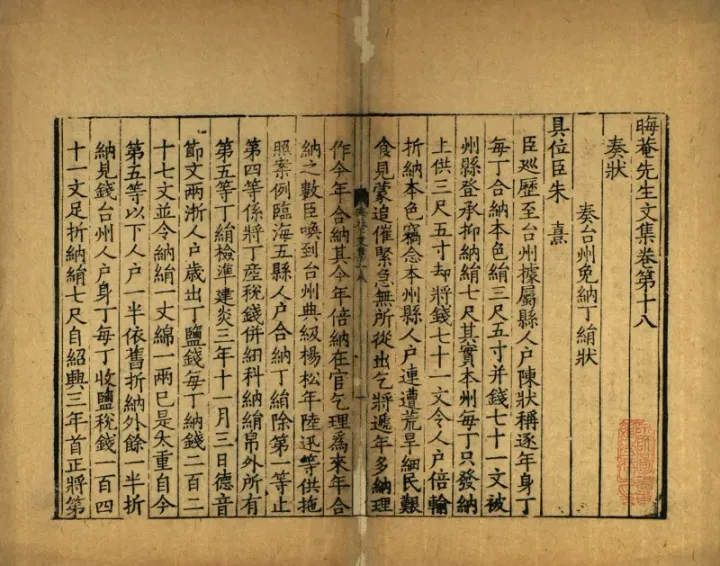
Zhu Xi's most consequential scholarly achievement was his elevation of four texts — the Great Learning, the Analects, the Mencius, and the Doctrine of the Mean — into a canonical sequence, and his writing of authoritative commentaries on each. His Sishu Jizhu (Collected Commentaries on the Four Books) became, from the Yuan dynasty onward, the mandatory curriculum for every civil service examination candidate in China. For nearly six hundred years, to be educated in China was to read Zhu Xi.
White Deer Grotto Academy
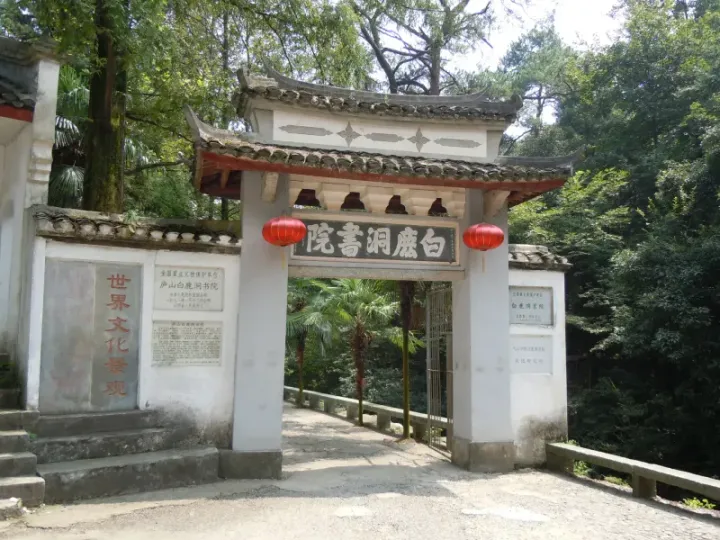
Appointed prefect of Nankang Military Prefecture in Jiangxi in 1179, Zhu Xi immediately set about rebuilding the White Deer Grotto Academy on Mount Lu — a venerable site that had fallen into ruin. He repaired the structures, drafted his celebrated Articles of the White Deer Grotto Academy, and invited the finest scholars of the age to teach there, including his philosophical rival Lu Jiuyuan. The articles he wrote — declaring that the purpose of learning was moral self-cultivation, not examination success — became the educational charter for all subsequent Chinese, Korean, and Japanese academies.
The Qingyuan Proscription
In 1196, the powerful minister Han Tuozhou launched a campaign against Neo-Confucian scholars, labelling their teachings weixue — 'False Learning.' Zhu Xi's name headed a list of fifty-nine proscribed scholars. His posts were stripped, his disciples were forbidden from gathering, and one official petitioned for his execution. Zhu Xi continued his scholarly work under persecution, revising his commentary on the Great Learning until his final days. He died in disgrace on April 23, 1200 — but his funeral drew hundreds of mourning disciples who came in defiance of the political ban.
Timeline
Birth in Youxi
Zhu Xi is born on October 18 in Youxi County, Fujian Province, to Zhu Song, a minor Confucian scholar and local official. The Southern Song dynasty has been established for three years following the Jurchen Jin dynasty's conquest of the north. From the age of five, the boy asks questions that astonish his elders — 'What lies beyond Heaven?' — and has mastered the Classic of Filiality by age eight.
Father's Death and Early Guardians
Zhu Song dies, leaving the thirteen-year-old Zhu Xi in the care of three scholars he had appointed: Liu Zihui, Liu Mianzhui, and Hu Xian — all inheritors of the Cheng brothers' Neo-Confucian tradition in Fujian. The young Zhu Xi is exposed to Confucian, Buddhist, and Daoist thought simultaneously. For the next decade, Chan Buddhism exerts a strong pull on his thinking.
Passes the Jinshi Examination
At the extraordinary age of eighteen or nineteen — the average age for passing is around thirty-five — Zhu Xi passes the highest level of the imperial civil service examination, the jinshi. His examination answers reportedly draw on Chan Buddhist ideas. The achievement makes him eligible for official appointment and marks him as one of the most intellectually gifted young men of his generation.
Registrar in Tongan
Zhu Xi serves as registrar in Tongan County, Fujian — his first official post. He implements administrative reforms, works to raise local educational standards, and begins intensive reflection on the Confucian texts. The experience of governance deepens his conviction that moral cultivation must precede political action. He grows increasingly dissatisfied with both Buddhist and Daoist frameworks during these years.
The Turn: Li Tong and Neo-Confucianism
Around 1160, Zhu Xi formally becomes a student of Li Tong (1093–1163), a master in the direct lineage of Cheng Yi and the decisive intellectual turning point of his life. Li Tong's method combines quiet sitting (jingzuo) — a meditative practice of moral attentiveness — with careful investigation of Confucian principle (li). Under Li Tong's guidance, Zhu Xi decisively abandons Buddhism and Daoism and commits to the Confucian path. Li Tong dies in 1163, leaving Zhu Xi as his intellectual heir.
The Goose Lake Temple Debate
In the summer of 1175, Lu Zuqian organises a meeting at Goose Lake Temple in Jiangxi between Zhu Xi and his philosophical rival Lu Jiuyuan (Lu Xiangshan). Lu Jiuyuan argues that moral knowledge is immediate and internal — 'The universe is my mind; my mind is the universe.' Zhu Xi maintains that cultivation requires systematic external investigation of principle in things and texts. The debate ends without resolution, founding two rival traditions — the Cheng-Zhu school and the Lu-Wang school — that will define Chinese intellectual life for centuries. In the same year, Zhu Xi and Lu Zuqian co-compile the Jinsilu (Reflections on Things at Hand).
White Deer Grotto Academy
Appointed prefect of Nankang Military Prefecture in Jiangxi, Zhu Xi rebuilds the White Deer Grotto Academy on Mount Lu from ruin. He drafts the Articles of the White Deer Grotto Academy — declaring that the purpose of learning is moral self-cultivation, not examination success — and invites Lu Jiuyuan to lecture there. Lu's lecture on righteousness versus profit moves many in the audience to tears, and Zhu Xi asks him to write it down and has it inscribed on a stone. The academy becomes the model for educational institutions across East Asia.
Prefect of Zhangzhou
Appointed prefect of Zhangzhou, Fujian, Zhu Xi introduces land tax reforms and attempts to reform local customs. His brief effective tenure — cited in scholarship as approximately forty-five days of active administration before court recall, though the exact figure is uncertain — illustrates his characteristic pattern: intense administrative engagement followed by dismissal or departure when his principled positions conflict with court politics. His memorial to Emperor Xiaozong, urging the emperor to first cultivate his own moral mind before implementing reforms, has already earned him powerful enemies.
The Qingyuan Proscription
The powerful minister Han Tuozhou launches the Qingyuan Proscription (Qingyuan Dang Jin), labelling Neo-Confucian teaching as weixue — 'False Learning.' Zhu Xi heads a list of fifty-nine condemned scholars. His posts are stripped, his disciples are forbidden from meeting, and one official petitions for his execution. The political campaign is the most severe persecution Neo-Confucianism has ever faced. Zhu Xi, now sixty-six, continues to revise his commentary on the Great Learning in silence.
Death and Funeral
Zhu Xi dies on April 23, 1200, at his home in Jianyang, Fujian, aged sixty-nine, with the proscription still in force. He is said to have been revising his commentary on the Great Learning until his final days — a detail that captures the integrity of his life's work. Despite the political danger of association with a condemned heretic, hundreds of disciples gather to mourn him. The funeral is an act of collective defiance.
Posthumous Rehabilitation
Han Tuozhou is killed in 1207 following his disastrous military campaign against the Jin dynasty. The proscription is lifted. Emperor Ningzong posthumously bestows on Zhu Xi the title 'Duke Wen of Hui' (Huiguo Wengong) — 'Cultured' or 'Civil,' the highest honorific. The rehabilitation is swift and complete: within years, the man condemned as a heretic is being spoken of as the greatest Confucian thinker since Mencius.
Enshrined Alongside Confucius
Zhu Xi's funerary tablet is installed in the Confucian Temple (Kong Miao) alongside those of Confucius, Mencius, and the other great sages — the highest posthumous honour in the Confucian tradition. He is ranked among the twelve philosophers (shizhe) of the temple. The man who was accused of ten crimes in 1196 is now worshipped alongside the very sages whose teachings he had spent his life interpreting.
The Four Books Become the Examination Standard
The Yuan dynasty officially adopts Zhu Xi's Sishu Jizhu (Collected Commentaries on the Four Books) as the mandatory basis for the imperial civil service examinations. For the next five hundred and ninety-two years — until the examinations are abolished in 1905 — every scholar in China who sits for official appointment must interpret the Confucian canon through Zhu Xi's lens. No philosopher in Chinese history has achieved a comparable institutional dominance.
Key Figures
Li Tong
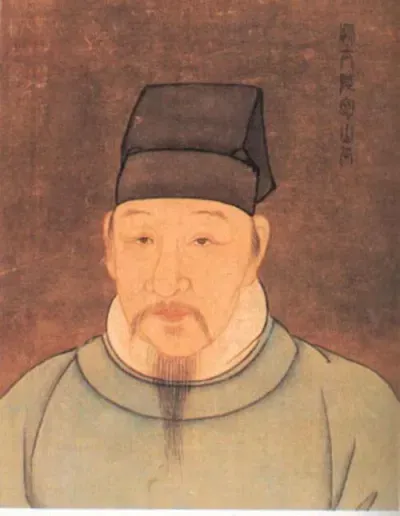
Li Tong (1093–1163) was the decisive intellectual turning point in Zhu Xi's life — the master who rescued him from Buddhism and set him on the path of Neo-Confucian cultivation. A student in the direct lineage of Cheng Yi, Li Tong taught a method combining quiet sitting (jingzuo) and the careful investigation of moral principle. Their relationship was intense and brief: Zhu Xi became Li Tong's student around 1160 and Li Tong died in 1163, leaving his disciple bereft but philosophically grounded. Zhu Xi mourned him as a father figure and credited him throughout his career as the one who had given him his philosophical inheritance. Li Tong had no posthumous fame of his own — that fell to his student.
Lu Jiuyuan
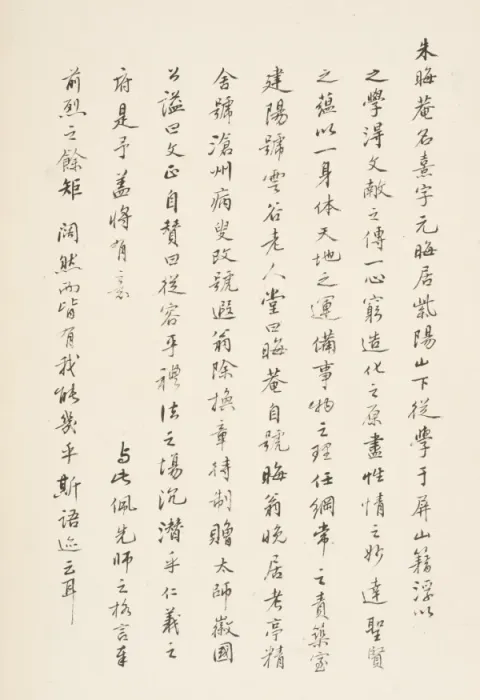
Lu Jiuyuan (1139–1193), known posthumously as Lu Xiangshan (Elephant Mountain), was the greatest philosophical rival of Zhu Xi's career — and, paradoxically, also his most respected peer. Their differences were fundamental: Lu insisted that the mind itself is principle, that moral knowledge is immediate and internal; Zhu maintained that cultivation requires the systematic, outward investigation of things. They met at the Goose Lake Temple in 1175 in a debate that ended without resolution but became legendary. Despite their disagreement, Zhu Xi invited Lu to lecture at his White Deer Grotto Academy in 1181, an act of intellectual generosity that Lu repaid with a lecture so moving it reduced the audience to tears. Lu died in 1193, seven years before his rival.
The Legacy of Zhu Xi
Zhu Xi died in disgrace on April 23, 1200, still under the Qingyuan Proscription, still revising the commentary that would define the intellectual tradition of East Asia for seven centuries. He had spent most of his career not in court but in provincial academies and scholarly retreats, teaching, writing, and corresponding with a network of thinkers who shared his conviction that the moral cultivation of the individual was the foundation of all right order in society and in the cosmos.
His paradox is inseparable from his greatness: the man who argued that self-cultivation must precede political action was himself a man of fierce political engagement who spent forty years trying to reform a court that repeatedly rejected him. The philosopher who taught that principle is one, though its manifestations are many, lived a life of relentless particularity — every memorial, every lesson, every revised sentence in the Great Learning commentary contributing to a single, lifelong project.
Within forty years of his death, his tablet stood in the Confucian Temple alongside Confucius and Mencius. Within a century, his commentaries were the law of the examination hall. Read his story in his own words — the doubts, the debates, the long years of obscure scholarship, and the final months of persecution — in the first-person ePub.
Get the Full Book
Read the story of Zhu Xi — 8 chapters of historical narrative.
Dramatised first-person narrative; not an autobiography.