
Eleanor Roosevelt
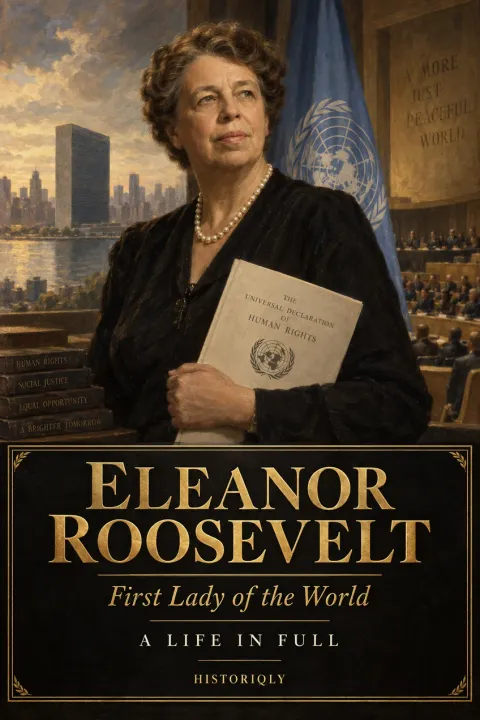
First Lady of the World
Get the full EPUB
Drop your email and the EPUB downloads straight to your device. We'll also ping you when the next chronicle lands — unsubscribe any time.
Your email is already on file — enjoy the read.
Download the EPUBAnna Eleanor Roosevelt transformed the role of First Lady from ceremonial figurehead into a force for social justice that reshaped American politics. Orphaned by age ten and raised in a world of rigid Victorian propriety, she emerged from personal tragedy, a painful marriage, and deep shyness to become the most influential woman of the twentieth century. As First Lady for an unprecedented twelve years, delegate to the United Nations, chair of the commission that drafted the Universal Declaration of Human Rights, and tireless champion of civil rights, she earned President Truman's tribute as the "First Lady of the World."
“No one can make you feel inferior without your consent.”
1884–1962
Born October 11, 1884, in Manhattan, New York City. Orphaned by age ten — her mother died of diphtheria when Eleanor was eight, her alcoholic father two years later. She transformed from a painfully shy child into perhaps the most influential woman of the twentieth century. Died November 7, 1962, and was buried beside Franklin at Hyde Park.
12
The longest-serving First Lady in American history, from March 4, 1933 to April 12, 1945 — spanning FDR's unprecedented four terms. She redefined the role from ceremonial hostess to active political advocate, holding 348 press conferences and traveling an average of 40,000 miles per year.
~8,000
Her syndicated newspaper column ran six days a week from December 31, 1935 to September 26, 1962 — nearly twenty-seven years without significant interruption. One of the longest-running syndicated columns by any public figure, reaching millions of readers daily across dozens of newspapers.
348
She held 348 press conferences as First Lady — all exclusively for women reporters. This deliberate strategy forced every major wire service and newspaper in America to hire or retain female journalists during the Depression, permanently changing the composition of the White House press corps.
Universal Declaration of Human Rights, transforming the role of First Lady, civil rights advocacy
Defining Events
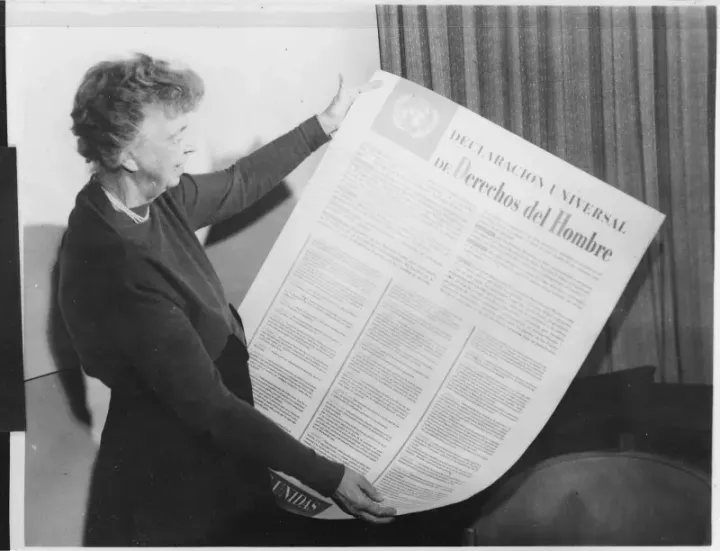
The Universal Declaration of Human Rights
As chair of the United Nations Commission on Human Rights, Eleanor Roosevelt helped negotiate the Universal Declaration with delegates from many countries. The General Assembly adopted it on 10 December 1948 with 48 votes in favour, none against and 8 abstentions. Its authorship was collective, and the negotiations involved disagreements within as well as between political blocs.
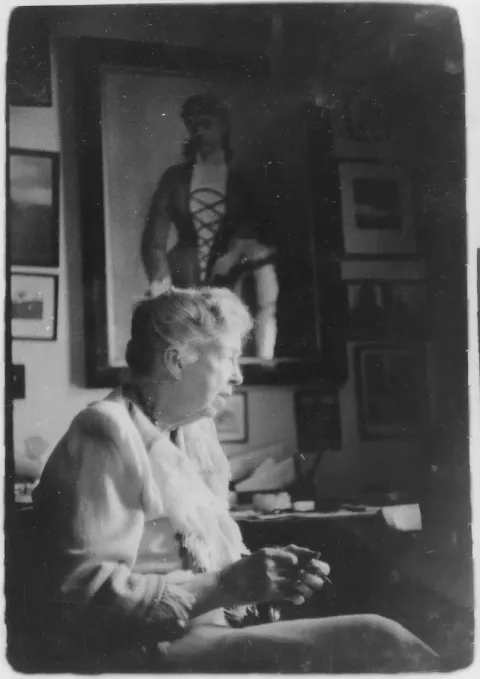
Transforming the Role of First Lady
Eleanor’s March 6, 1933 press conference begins a series reserved for women journalists. These meetings encourage news organizations to employ women to cover her. Her travel, column, broadcasts and advocacy bring the role of First Lady into continuing political debate, though access to that platform remains unequal and her influence has limits.
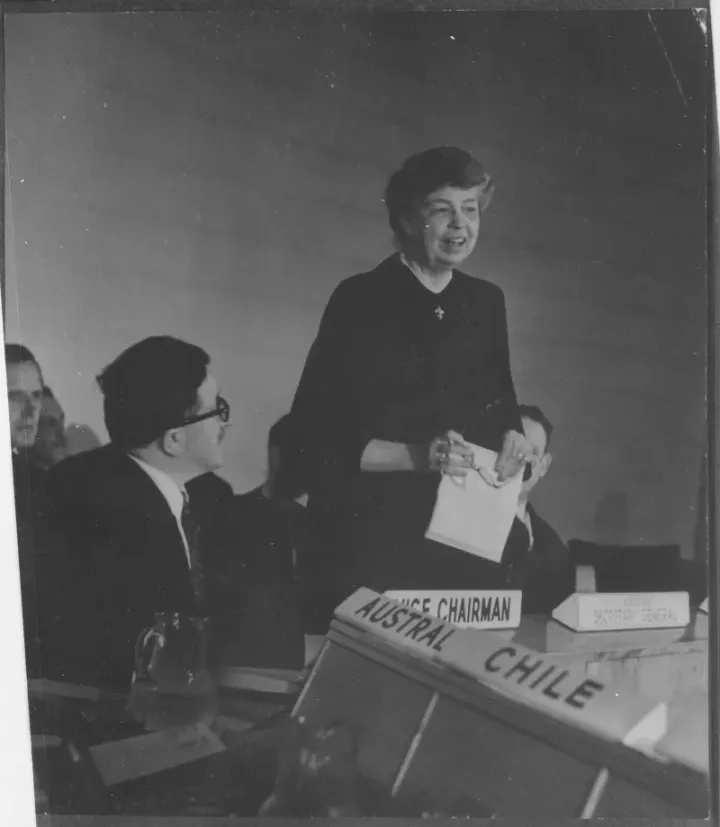
The Marian Anderson Concert
When the Daughters of the American Revolution refused to allow the celebrated African American contralto Marian Anderson to perform at Constitution Hall, Eleanor Roosevelt took a stand that reverberated across the nation. On February 26, 1939, she publicly resigned her DAR membership, writing that the organisation had 'set an example which seems to me unfortunate.' She then worked with Interior Secretary Harold Ickes to arrange an open-air concert at the Lincoln Memorial. On Easter Sunday, April 9, 1939, Anderson sang before 75,000 people and a national radio audience of millions, opening with 'My Country, 'Tis of Thee.' The event became one of the most iconic moments in the American civil rights movement.
Timeline
Childhood Losses
Eleanor loses her mother in 1892, her brother Elliott Jr. in 1893 and her father in 1894, before her tenth birthday. She grows up largely under her maternal grandmother’s care. Later recollections describe the loneliness of those years without making bereavement a complete explanation of her public life.
Allenswood Academy
At fifteen, Eleanor was sent to Allenswood Academy, a progressive boarding school near London run by the pioneering French educator Marie Souvestre. For three transformative years, Souvestre recognised Eleanor's intellect, took her on travels through Europe, and cultivated her independence. Eleanor later called these 'the happiest years of my life.' She returned to New York in 1902 a fundamentally changed young woman — confident, curious, and committed to public service.
Marriage to Franklin Roosevelt
On St. Patrick's Day, March 17, 1905, Eleanor married her fifth cousin once removed, Franklin Delano Roosevelt. President Theodore Roosevelt gave the bride away. The marriage would produce six children and evolve through deep personal crisis — including FDR's 1918 affair with Lucy Mercer — into one of the most consequential political partnerships in American history, with Eleanor serving as Franklin's moral compass and public surrogate.
Redefining the First Lady
Eleanor becomes First Lady and holds her first press conference on March 6, admitting women reporters. Her 348 conferences create opportunities for women in political journalism. Travel, broadcasting and the My Day column become further parts of her public work.
The Marian Anderson Concert
After the Daughters of the American Revolution barred African American contralto Marian Anderson from Constitution Hall, Eleanor publicly resigned from the DAR and helped arrange an alternative concert at the Lincoln Memorial. On Easter Sunday, April 9, 1939, Anderson sang before 75,000 people and a national radio audience. The event became a landmark moment in the civil rights movement, demonstrating the power of moral courage and turning racial discrimination into front-page national news.
FDR's Death and a New Chapter
On April 12, 1945, Franklin Roosevelt died of a cerebral haemorrhage at Warm Springs, Georgia. Eleanor told reporters simply, 'The story is over.' But a new chapter was beginning. In December 1945, President Harry Truman appointed her as a U.S. delegate to the United Nations General Assembly, recognising that her moral authority and international stature made her uniquely qualified to help shape the postwar world order.
The Universal Declaration of Human Rights
Roosevelt chaired the Commission on Human Rights during the drafting of the Universal Declaration. The General Assembly adopted it on 10 December 1948 with 48 votes in favour, none against and 8 abstentions. Her leadership was one part of a multinational drafting and negotiation process.
Death and Legacy
Eleanor Roosevelt died on November 7, 1962, at age seventy-eight, in New York City. She was buried beside Franklin at their Hyde Park estate. Her funeral was attended by President Kennedy and former presidents Truman and Eisenhower. Adlai Stevenson eulogised her by saying she 'would rather light a candle than curse the darkness.' The New York Times wrote that she had been 'more involved in the minds and hearts and aspirations of people than any other First Lady in history.'
Key Figures
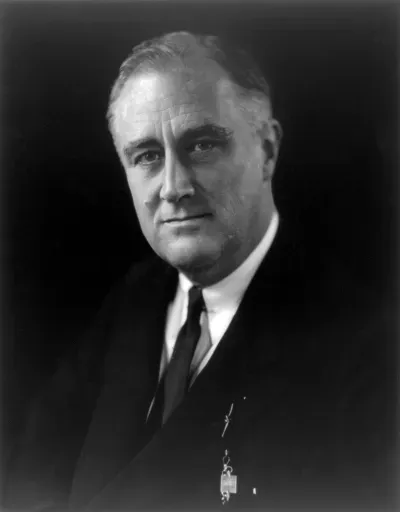
Franklin D. Roosevelt
Eleanor and Franklin's marriage, which began with genuine affection in 1905, was shattered in 1918 when Eleanor discovered his affair with her social secretary Lucy Mercer. She offered a divorce; Franklin refused under pressure from his mother Sara, who threatened to disinherit him. From this rupture emerged one of the most powerful political partnerships in American history. Eleanor became FDR's surrogate in the field — his 'eyes and ears' — traveling where his paralysis from polio prevented him from going. She pushed him leftward on civil rights and labour issues; he gave her an unparalleled platform. When FDR died in April 1945, Lucy Mercer was at his bedside — a final wound Eleanor bore with characteristic stoic dignity.
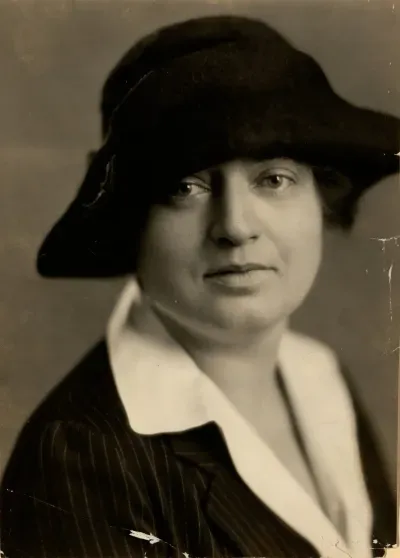
Lorena Hickok
Lorena 'Hick' Hickok was one of America's most accomplished female journalists — the Associated Press's top female reporter — when she was assigned to cover Eleanor during FDR's 1932 presidential campaign. The two developed an intense bond lasting thirty years, exchanging nearly 3,500 letters, sometimes writing twice daily. It was Hickok who suggested Eleanor hold women-only press conferences, and Hickok who encouraged her to use the First Lady platform to advocate for the marginalised. Hickok sacrificed her journalism career due to the conflict of interest, leaving the AP in 1933 and eventually moving into the White House for four years.
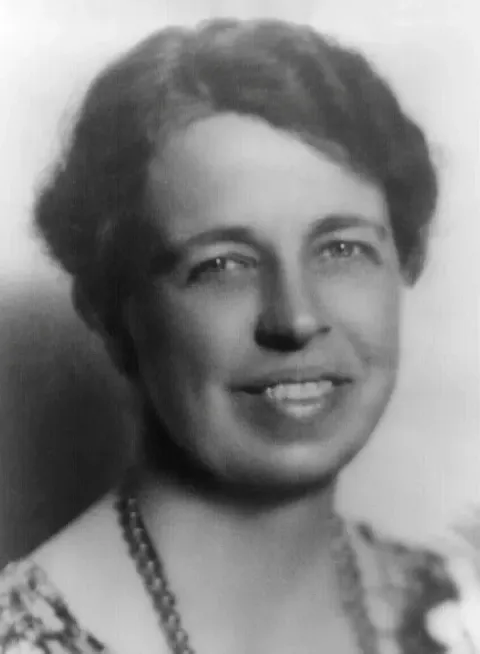
The Legacy of Eleanor Roosevelt
Eleanor Roosevelt's legacy endures as a testament to the power of moral courage and relentless compassion. From the orphan who found her voice at a London boarding school to the diplomat who convinced a fractured postwar world to agree on fundamental human rights, she demonstrated that empathy and determination could reshape history.
Her 8,000 newspaper columns, 348 press conferences, and decades of advocacy for racial justice, women's rights, and the dispossessed established a model of public service that transcends political eras. She proved that influence need not come from elected office — it can come from an unshakable commitment to human dignity. Read her story in her own words in the first-person ePub.
Get the Full Book
Read the story of Eleanor Roosevelt — 8 chapters of historical narrative.
Dramatised first-person narrative; not an autobiography.