
Ernest Hemingway
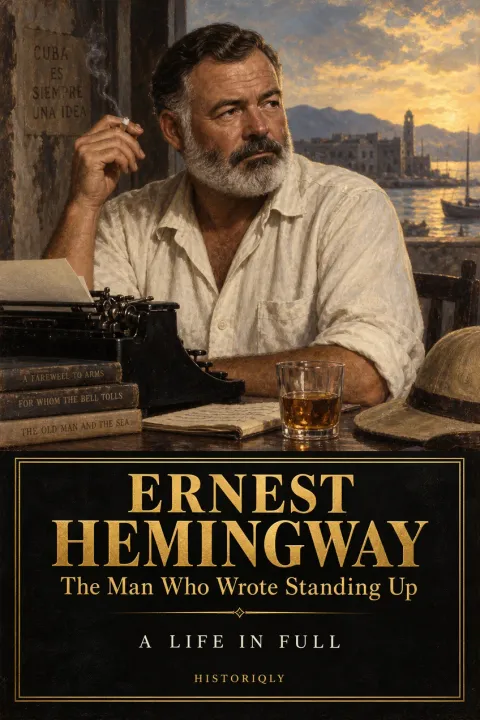
The Man Who Wrote Standing Up
Get the full EPUB
Drop your email and the EPUB downloads straight to your device. We'll also ping you when the next chronicle lands — unsubscribe any time.
Your email is already on file — enjoy the read.
Download the EPUBOn July 8, 1918, Ernest Hemingway was wounded near Fossalta di Piave while serving with the American Red Cross. His injury and recovery became part of both his writing and his public legend. The work that followed drew on more than the war: journalism, reading, friendship, travel and sustained revision all contributed to his style. His fiction and the stories he told about himself do not always provide the same kind of evidence.
“All you have to do is write one true sentence. Write the truest sentence that you know.”
1899–1961
Born July 21, 1899, in Oak Park, Illinois. Died July 2, 1961, in Ketchum, Idaho. Sixty-one years that produced some of the most influential prose in the English language.
1954
Awarded the Nobel Prize in Literature “for his mastery of the art of narrative, most recently demonstrated in The Old Man and the Sea, and for the influence that he has exerted on contemporary style.”
7
Seven published novels including The Sun Also Rises (1926), A Farewell to Arms (1929), For Whom the Bell Tolls (1940), and The Old Man and the Sea (1952). Several more published posthumously.
4
Four marriages, four divorces or deaths: Hadley Richardson (1921–1927), Pauline Pfeiffer (1927–1940), Martha Gellhorn (1940–1945), Mary Welsh (1946–1961). He once said he traded in wives like cars.
Nobel Prize-winning novelist, war correspondent, pioneer of modern American prose
Defining Events
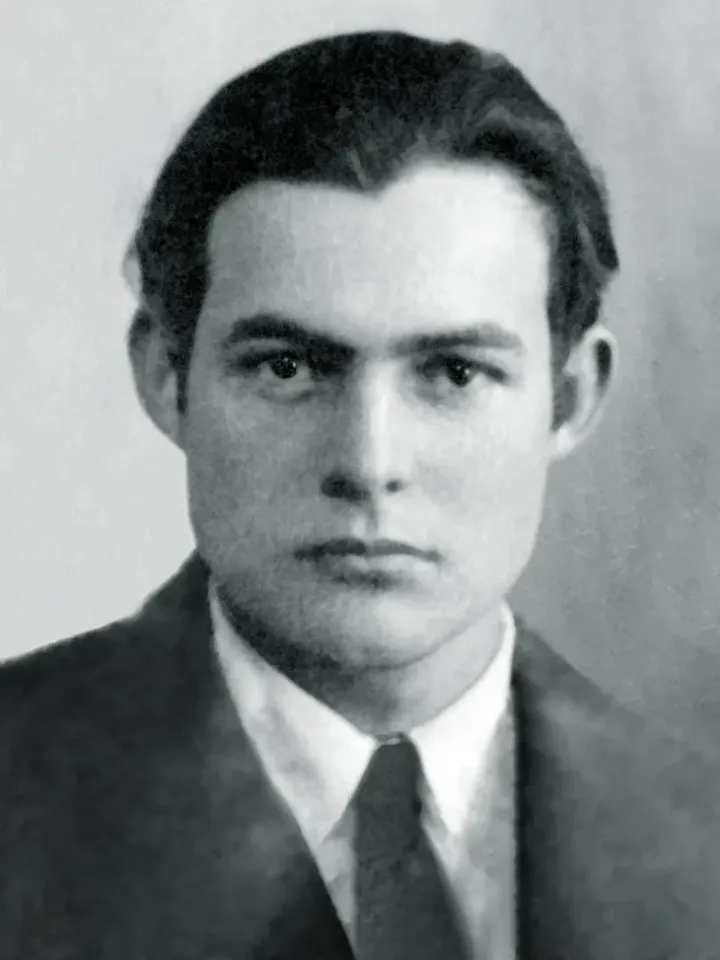
Paris and the Lost Generation
In December 1921, Hemingway and his first wife Hadley Richardson sailed for Paris on the advice of Sherwood Anderson. They settled in the Latin Quarter, and Hemingway apprenticed himself to the craft of writing with a monastic discipline that would define his career. He wrote standing up, in longhand, in the mornings, and spent his afternoons in the cafés of Montparnasse with Gertrude Stein, Ezra Pound, James Joyce, and F. Scott Fitzgerald. Stein became his mentor and coined the phrase that would name their cohort: “You are all a lost generation.” In Paris, Hemingway developed the spare, declarative style — what he called the “iceberg theory” — that would revolutionise American prose. The Sun Also Rises (1926) and A Farewell to Arms (1929) made him the most celebrated young writer in the world.
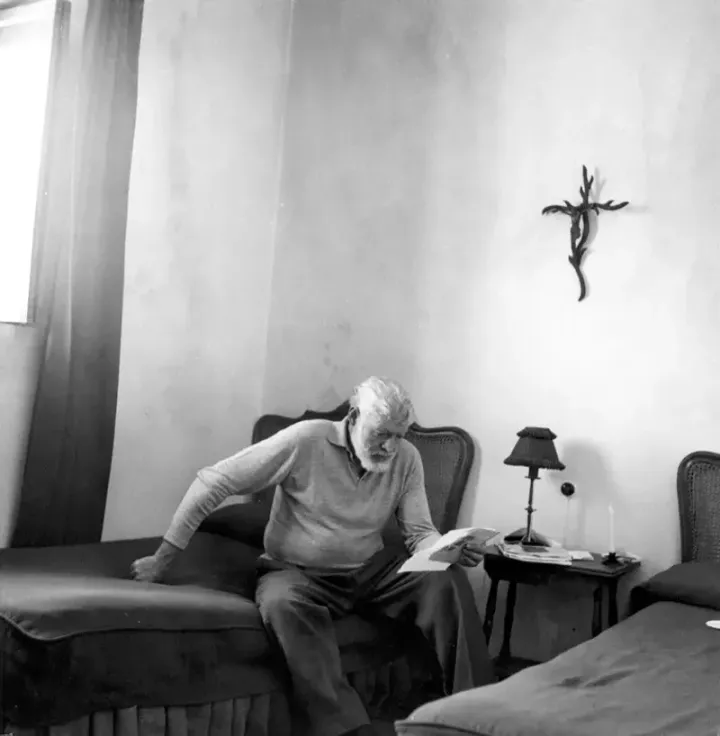
The Spanish Civil War
Hemingway covered the Spanish Civil War as a correspondent for the North American Newspaper Alliance, but he was never just a reporter. He raised money for the Republican cause, helped produce the documentary film The Spanish Earth with Joris Ivens, and lived at the Hotel Florida in Madrid while the city was under siege. The war gave him the material for For Whom the Bell Tolls (1940), the novel that cemented his reputation and sold half a million copies in its first year. It also gave him Martha Gellhorn, the brilliant war correspondent who became his third wife — and the only one who left him.
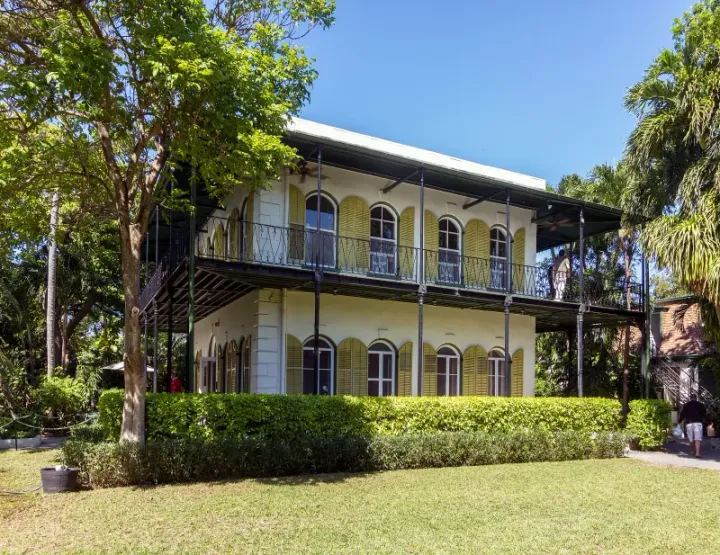
The Old Man and the Sea
After a decade of critical disappointment following the poorly received Across the River and into the Trees (1950), Hemingway published a novella about an old Cuban fisherman’s epic battle with a giant marlin in the Gulf Stream. The Old Man and the Sea appeared in its entirety in a single issue of Life magazine, which sold 5.3 million copies in two days. The book won the Pulitzer Prize for Fiction in 1953 and was cited specifically when Hemingway was awarded the Nobel Prize in Literature the following year. It was the last major work published in his lifetime, and many consider it his finest.
Timeline
Born in Oak Park
Ernest Miller Hemingway was born on July 21, 1899, in Oak Park, Illinois, a prosperous suburb of Chicago. His father Clarence was a physician and outdoorsman who taught him to hunt and fish in northern Michigan. His mother Grace was a music teacher who wanted him to play the cello. He chose words instead, writing for the high school newspaper and literary magazine.
Wounded in Italy
Serving with the American Red Cross near the Italian front, Hemingway is wounded on July 8. He receives an Italian decoration and spends months recovering in Milan, where he forms an attachment to nurse Agnes von Kurowsky. Later fiction draws on these experiences without reproducing them as a straightforward autobiography.
The Sun Also Rises
Published his first novel, a thinly veiled account of his life among the expatriate community in Paris and Pamplona. The book captured the disillusionment of the post-war generation, introduced Jake Barnes as one of literature’s great wounded narrators, and established Hemingway’s spare prose style as the new benchmark for American fiction. He was twenty-seven years old.
A Farewell to Arms
His second major novel, drawn from his experience as a wounded ambulance driver in Italy, became an immediate bestseller and confirmed him as the leading American novelist of his generation. The love story between Frederic Henry and Catherine Barkley, set against the chaos of the Italian front, demonstrated Hemingway’s ability to write about war and love with equal precision.
For Whom the Bell Tolls
Published the novel that many consider his masterpiece — a story of an American dynamiter behind enemy lines during the Spanish Civil War, compressed into seventy-two hours of tension, loyalty, and sacrifice. The book sold half a million copies in its first year, was nominated for the Pulitzer Prize, and was adapted into a major film starring Gary Cooper and Ingrid Bergman.
Pulitzer and Nobel
Won the Pulitzer Prize for Fiction in 1953 for The Old Man and the Sea, and the Nobel Prize in Literature in 1954. He was too injured to attend the Nobel ceremony in Stockholm — he had survived two plane crashes in Africa in January 1954 and was still recovering from burns, a cracked skull, a ruptured liver, and a crushed vertebra. Several newspapers had prematurely published his obituary.
Death in Ketchum
Hemingway died by suicide at his home in Ketchum on 2 July 1961, aged 61, after serious physical and psychiatric illness and treatment at the Mayo Clinic. His death cannot be reduced to a single treatment or a simple loss-of-writing explanation. Posthumously published work included A Moveable Feast and The Garden of Eden.
Key Figures
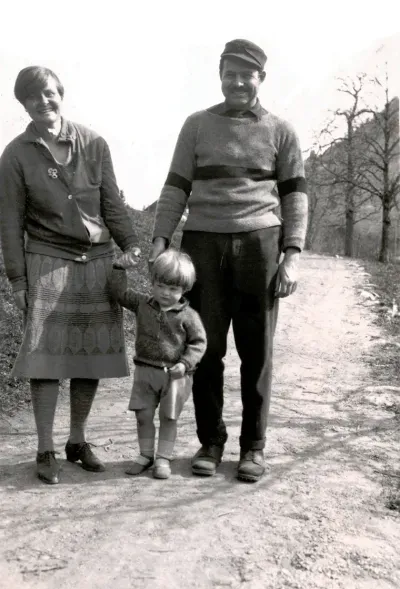
Hadley Richardson
Elizabeth Hadley Richardson was eight years older than Hemingway when they married on September 3, 1921. She supported him financially during the lean Paris years, believed in his talent before anyone else did, and bore their son John (“Bumby”) in 1923. Hemingway repaid her devotion by falling in love with her friend Pauline Pfeiffer. They divorced in 1927, and Hemingway later called the end of their marriage the greatest mistake of his life. In A Moveable Feast, written decades later, he portrayed their Paris years as the happiest of his life — and the loss of Hadley as the original sin from which everything else followed.
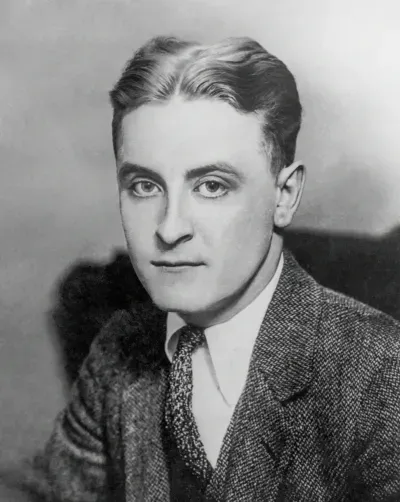
F. Scott Fitzgerald
They met in the Dingo Bar in Paris in May 1925 — Fitzgerald already famous for The Great Gatsby, Hemingway still largely unpublished. Fitzgerald championed Hemingway’s work to his editor Maxwell Perkins at Scribner’s, a connection that launched Hemingway’s career. But the friendship curdled. Hemingway came to see Fitzgerald as weak, alcohol-ruined, and dominated by his wife Zelda. Fitzgerald saw in Hemingway a ruthlessness that discarded people once they were no longer useful. In A Moveable Feast, Hemingway wrote about Fitzgerald with a mixture of tenderness and cruelty that has fascinated literary scholars ever since.
The Legacy of Ernest Hemingway
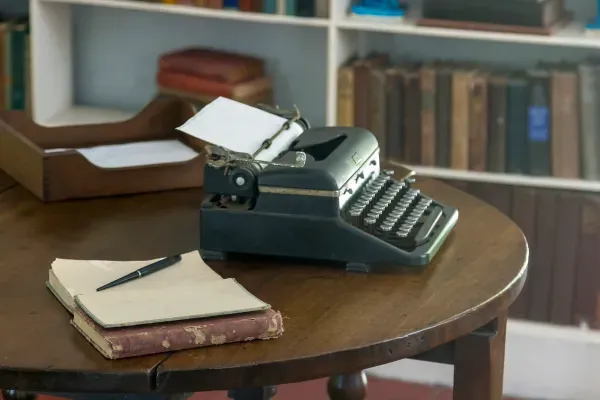
Hemingway's fiction changed the possibilities of the English sentence. Its restraint was the result of revision and a distinctive attention to what a narrative could leave unsaid. His letters, manuscripts and published work offer different views of that practice.
His illness and death should be considered with the same care as his prose. Treatment, alcohol, physical illness and psychiatric symptoms form a complex history; they do not support a story in which suffering made him an artist or suicide completed his work. The book presents a dramatised reconstruction, not Hemingway's own testimony.
Get the Full Book
Read the story of Ernest Hemingway — 8 chapters of historical narrative.
Dramatised first-person narrative; not an autobiography.