
Nelson Mandela
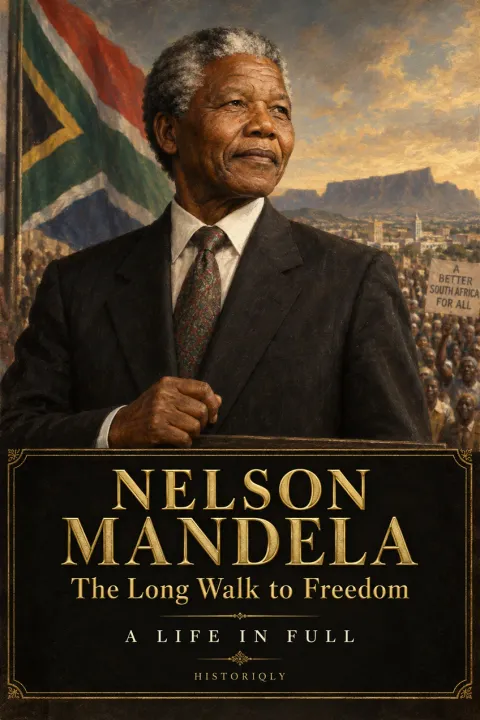
The Long Walk to Freedom
Get the full EPUB
Drop your email and the EPUB downloads straight to your device. We'll also ping you when the next chronicle lands — unsubscribe any time.
Your email is already on file — enjoy the read.
Download the EPUBOn February 11, 1990, a seventy-one-year-old man walked through the gates of Victor Verster Prison into the South African sunlight and raised his fist to a crowd of thousands. He had entered prison in 1962 as a fugitive revolutionary. He emerged as the most famous political prisoner on Earth. Nelson Rolihlahla Mandela had spent 10,052 days behind bars — nearly a third of his life — and in that time, he had been transformed from a militant freedom fighter into the symbol of a struggle that had captured the conscience of the world. Four years later, he would become the first Black president of South Africa, leading a nation that many had expected to dissolve into racial civil war toward a peaceful transition that remains one of the twentieth century’s most improbable achievements.
“It always seems impossible until it’s done.”
1918–2013
Born Rolihlahla Mandela on July 18, 1918, in the village of Mvezo on the banks of the Mbashe River in the Eastern Cape. Died in Johannesburg on December 5, 2013, at ninety-five — mourned by the entire world.
27
From August 5, 1962, to February 11, 1990, Mandela was held in South African prisons — eighteen of those years on Robben Island, breaking limestone in a quarry under a sun that permanently damaged his eyesight.
1994–1999
Served one term as president, fulfilling his promise to step down voluntarily — a rarity in post-colonial Africa and a deliberate statement that power must be surrendered as gracefully as it is won.
1993
Shared the Nobel Peace Prize with F.W. de Klerk for their joint work in negotiating the peaceful end of apartheid and the transition to multiracial democracy in South Africa.
Anti-apartheid revolutionary, political prisoner for 27 years, first Black president of South Africa, Nobel Peace Prize laureate
Defining Events
The Rivonia Trial
In October 1963, Mandela and nine co-defendants stood trial for sabotage and conspiracy to overthrow the state. The prosecution sought the death penalty. On April 20, 1964, Mandela delivered his famous speech from the dock: “I have cherished the ideal of a democratic and free society in which all persons live together in harmony and with equal opportunities. It is an ideal which I hope to live for and to achieve. But if needs be, it is an ideal for which I am prepared to die.” He was sentenced to life imprisonment. The speech, reported worldwide, transformed a courtroom defence into a manifesto that would echo for decades.
Release from Prison
After 10,052 days of imprisonment, Mandela walked free from Victor Verster Prison, hand in hand with his then-wife Winnie, into a world that had changed beyond recognition. The Berlin Wall had fallen three months earlier. The Cold War was ending. And South Africa’s apartheid government, squeezed by international sanctions, internal resistance, and the collapse of its Soviet bogeyman, had no choice but to negotiate. Hundreds of millions of people worldwide watched the moment on television.
Inauguration as President
Nelson Mandela was inaugurated as the first Black president of South Africa before tens of thousands of spectators at the Union Buildings in Pretoria — the same building from which apartheid had been administered for decades. Among the guests: the prison warders who had guarded him on Robben Island, whom he had personally invited. “Never, never, and never again shall it be that this beautiful land will again experience the oppression of one by another,” he declared. It was a promise, a prayer, and a warning, delivered by a man who had earned the right to make all three.
Timeline
Born in Mvezo
Born Rolihlahla Mandela on July 18 in the village of Mvezo, Transkei, to Gadla Henry Mphakanyiswa, a chief of the Thembu people, and Nosekeni Fanny. His given name, Rolihlahla, means ‘pulling the branch of a tree’ — colloquially, ‘troublemaker.’ He received the name ‘Nelson’ from a schoolteacher on his first day of primary school, as was the custom for African children in British-influenced schools.
Fled to Johannesburg
At twenty-two, Mandela fled to Johannesburg to escape an arranged marriage organised by his guardian, the regent Jongintaba Dalindyebo. He arrived in the city with almost nothing, worked as a mine security guard, and eventually enrolled at the University of the Witwatersrand to study law — the only Black student in the law faculty.
Joined the ANC
Joined the African National Congress and co-founded its Youth League with Walter Sisulu and Oliver Tambo. The Youth League pushed the ANC away from polite petitions toward mass action — strikes, boycotts, and civil disobedience — modelled on Gandhi’s campaigns in India and South Africa decades earlier.
The Defiance Campaign
Led the ANC’s Defiance Campaign against unjust laws — the largest civil disobedience action in South African history to that point. Over 8,500 volunteers were arrested for deliberately violating apartheid statutes. Mandela, as volunteer-in-chief, was convicted under the Suppression of Communism Act and given a suspended sentence.
The Treason Trial
Arrested with 155 others and charged with high treason. The trial dragged on for five years and ended in acquittal for all defendants. During the trial, Mandela divorced his first wife Evelyn Mase and married Winnie Madikizela, a social worker who would become one of the most controversial figures in South African politics.
Went Underground
After the Sharpeville massacre of 1960 and the banning of the ANC, Mandela went underground. He co-founded Umkhonto we Sizwe (Spear of the Nation), the armed wing of the ANC, and led a sabotage campaign targeting government infrastructure. He travelled secretly to Algeria, Ethiopia, and England to raise support and receive military training.
Sentenced to Life
Mandela and seven co-defendants receive life sentences on June 12, 1964. Mandela returns to Robben Island, where he remains until the 1982 transfer to Pollsmoor. Work, study and collective political life develop under severe prison restrictions; his LLB is eventually completed through Unisa in 1989.
Released from Prison
Walked free from Victor Verster Prison on February 11 after 10,052 days of imprisonment. President F.W. de Klerk had unbanned the ANC, the South African Communist Party, and thirty other organisations nine days earlier. The negotiations that would end apartheid had begun.
Key Figures
F.W. de Klerk
Frederik Willem de Klerk, the last apartheid-era president of South Africa, was an unlikely reformer — a conservative Afrikaner from a family of National Party politicians. Yet in February 1990, he unbanned the ANC, released Mandela, and dismantled the legal framework of apartheid. The two men shared the Nobel Peace Prize in 1993, though their relationship was tense and mistrustful. Mandela respected de Klerk’s courage in choosing negotiation over civil war, but never fully trusted his sincerity — “a man of integrity,” Mandela said, “who had not yet made the full leap.”
Walter Sisulu
Walter Sisulu helped Mandela find professional opportunities and became a close ANC colleague. Sisulu was arrested at Liliesleaf in 1963 while Mandela was already in prison. They were later defendants together at Rivonia and fellow prisoners on Robben Island and at Pollsmoor. Their partnership was one among the many relationships that sustained the movement.
The Legacy of Nelson Mandela
Mandela helped lead South Africa from apartheid to democratic government through struggle and negotiation. His imprisonment shaped his political life, but it should not be treated as a simple story in which suffering automatically produced wisdom.
His presidency supported reconciliation through institutions as well as gestures. The Truth and Reconciliation Commission offered conditional amnesty under legal requirements, and victims could dispute that settlement. The 1995 Rugby World Cup provided a powerful public image of inclusion; it did not erase inequality or unite every South African. The book uses a dramatised first-person voice, with the limits of that reconstruction made explicit.
Get the Full Book
Read the story of Nelson Mandela — 8 chapters of historical narrative.
Dramatised first-person narrative; not an autobiography.