
Shankara
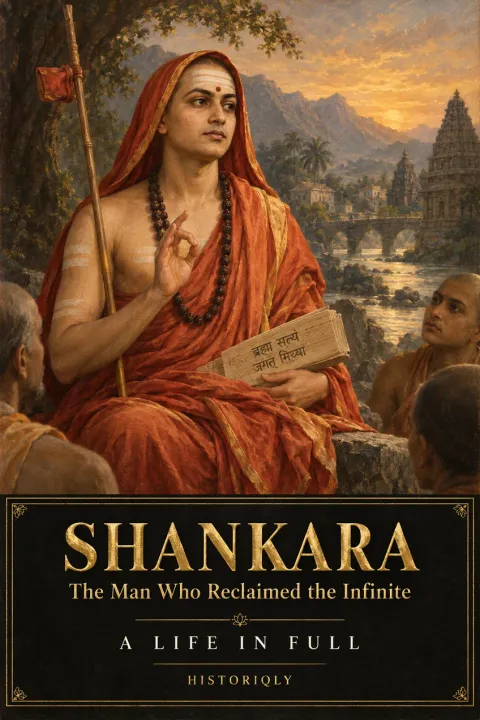
The Man Who Reclaimed the Infinite
Get the full EPUB
Drop your email and the EPUB downloads straight to your device. We'll also ping you when the next chronicle lands — unsubscribe any time.
Your email is already on file — enjoy the read.
Download the EPUBAround 788 CE, in the village of Kaladi on the banks of the Purna river in Kerala, a Nambudiri Brahmin child named Shankara was born who would — in barely three decades of life — walk the length of the Indian subcontinent, compose the most important philosophical commentaries in Sanskrit literature, defeat every major rival school of thought in open debate, and establish four monasteries at the four cardinal directions of India that still transmit his teaching thirteen centuries later. He called his philosophy Advaita Vedanta: the non-dual interpretation of the ancient Upanishads. Its core claim is both the simplest and the most radical in the history of ideas — that the individual self and the ultimate ground of reality are one and the same.
“Brahma satyam jagat mithyam, jivo brahmaiva naparah.”
c. 788–820 CE
Born in Kaladi, Kerala, c. 788 CE. Died at Kedarnath in the Himalayas, c. 820 CE, at approximately thirty-two years of age. The dates are disputed — some Indian traditions place him centuries earlier — but modern scholarship generally accepts the 788–820 CE range as the most consistent with the textual evidence.
300+
Shankara is attributed with over three hundred works — though modern scholars consider perhaps a dozen certainly authentic. These include commentaries on the ten principal Upanishads, the Brahma Sutras, and the Bhagavad Gita, plus independent philosophical treatises and devotional hymns. Together they constitute the most influential body of philosophical work in the history of Indian thought.
4
Four major monastic centres trace their foundation to Shankara. Their lineage narratives preserve the tradition’s understanding of his authority; the detailed founding history requires distinction from later institutional memory.
32
In the same span of years that Alexander the Great had to conquer the known world, Shankara composed the most sophisticated philosophical commentaries in Sanskrit history, traversed the entire Indian subcontinent on foot, and defeated — by the biographical tradition's account — every major rival philosophical school. The brevity of his life is itself part of the legend.
Founder of Advaita Vedanta, philosopher of non-dualism, unifier of Hindu thought across India
Defining Events
The Brahmasutra Bhashya
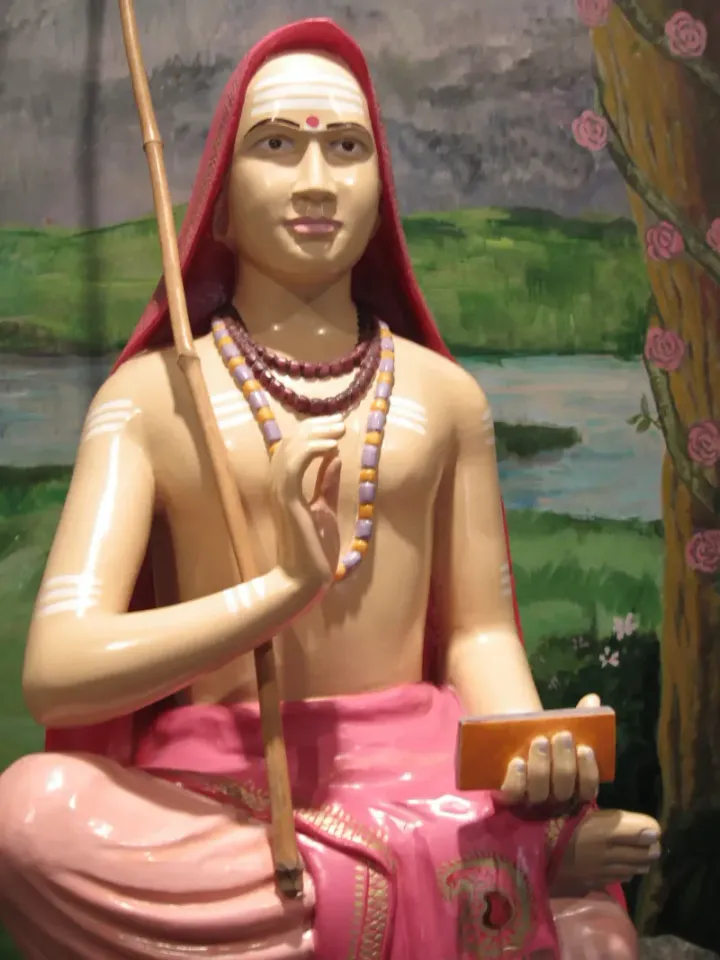
Composed in Varanasi, Shankara's commentary on the Brahma Sutras of Badarayana is his philosophical masterwork — the text that made Advaita Vedanta the dominant school of Indian philosophy and set the terms of debate for every subsequent thinker, from Ramanuja to Madhva to Vivekananda. Every major Vedanta school is required to write a commentary on the Brahma Sutras; Shankara's was the first comprehensive one, and the most consequential.
The Great Debate at Mahishi
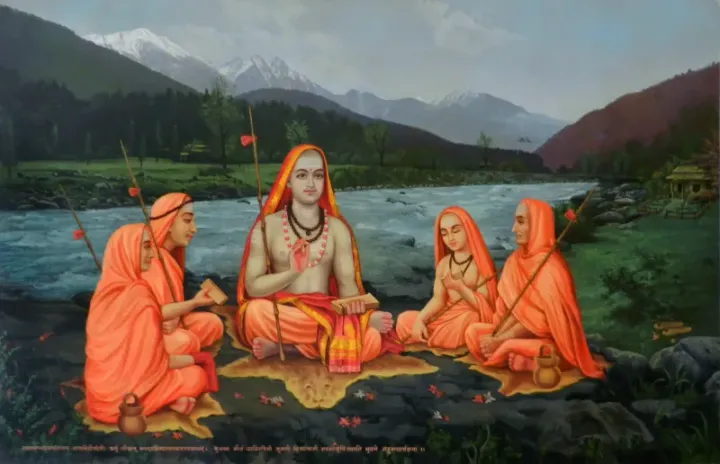
Later hagiographies celebrate a debate with Mandana Mishra, judged by Ubhaya Bharati and decided through the sign of wilting garlands. The episode expresses the tradition’s account of philosophical victory; it is not a secure transcript. Mandana’s identification with Suresvara remains disputed.
The Four Mathas
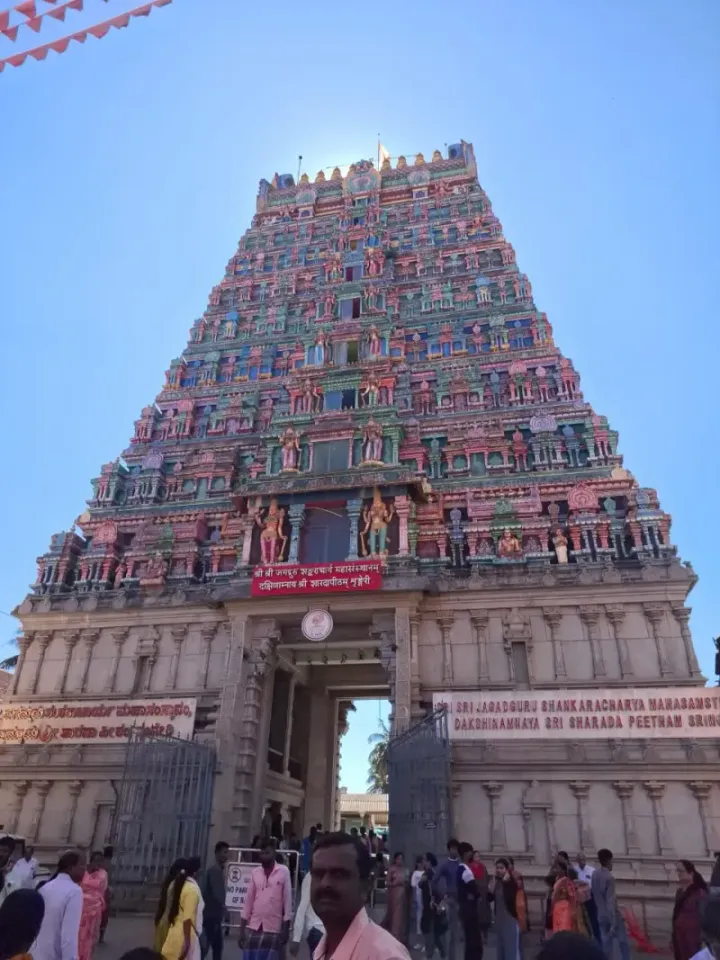
Four major monastic centres honour Shankara as their founder. Their institutional traditions connect lineages, disciples and teachings to him, but the surviving historical evidence does not fix a detailed personal founding itinerary.
Timeline
Birth at Kaladi
Shankara is born in the village of Kaladi on the banks of the Purna river in present-day Ernakulam district, Kerala. His father, Shivaguru, is a devout Nambudiri Brahmin; his mother, Aryamba, is deeply devoted to Shiva. Shivaguru dies when Shankara is approximately seven years old, leaving the prodigious child to be raised solely by his mother. Traditional accounts describe him mastering all four Vedas by the age of eight — an achievement that normally required decades of study in the Nambudiri tradition.
The Crocodile and the Renunciation
The pivotal moment of Shankara's youth: while bathing in the Purna river, a crocodile seizes his leg and drags him under. He cries out to his mother for permission to take sannyasa — formal monastic renunciation — before death, so that he might die as a monk. His mother, fearing she will lose him entirely, grants permission. The crocodile releases him. This episode — called apatsannyasa, emergency renunciation — may encode something historically real: Shankara took vows of renunciation at an extraordinarily young age, against his family's expectations, driven by an unshakeable conviction that only the path of jnana could lead to liberation.
The Cave at Omkareshvara
Having renounced household life, the young Shankara sets out north from Kerala in search of a qualified teacher. He crosses the Deccan plateau to the Narmada river valley and arrives at Omkareshvara — a sacred island in the river, home to one of the twelve jyotirlingas (self-manifest Shiva shrines). There, meditating in a cave, he finds his guru: Govindapada (Govinda Bhagavatpada), a monk of the Dasanami tradition and disciple of the great Gaudapada. Shankara announces himself through a spontaneous Sanskrit verse. Govindapada recognizes an exceptional student, accepts him, and initiates him formally into the Advaita tradition.
Kashi — The Great Commentaries
Govindapada sends Shankara to Varanasi (Kashi) — the sacred city on the Ganga and the intellectual capital of classical India — to write his commentaries. In Kashi, Shankara composes the Brahmasutra Bhashya, his commentaries on the ten principal Upanishads, and the Bhagavad Gita Bhashya. It is here, too, that the encounter with the Chandala on the steps of the Ganga ghats occurs — Shiva himself in disguise, challenging Shankara's understanding of non-duality with a question no logic could answer: if the Atman is everywhere, who is asking whom to step aside?
The Debate with Mandana Mishra
Later hagiographies describe a debate with Mandana Mishra, judged by Ubhaya Bharati, and a conversion symbolised by wilting garlands. These episodes are transmitted religious biography. Whether Mandana and the disciple Suresvara were the same historical person remains disputed.
The Digvijaya — Conquest of the Directions
Shankara's pan-Indian tour of debate and teaching: south to Srirangam, Ramesvaram, and the Tamraparni; west to Ujjain, Dwaraka on the Gujarat coast; east to Puri and the Jagannatha temple in Odisha; north to Badrinath, Kedarnath, and the high Himalayas. Wherever he goes he debates the champions of rival schools — Mimamsakas, Samkhyas, Vaisheshikas, and Buddhist logicians — and establishes Advaita as the dominant interpretation of the Upanishadic tradition. He founds the four Amnaya Mathas, appointing Suresvara (south/Sringeri), Hastamalaka (west/Dwaraka), Padmapada (east/Puri), and Totakacharya (north/Joshimath) as their first heads.
The Mother's Last Rites
Shankara returns to Kerala when he learns his mother Aryamba is dying. A sannyasin, by monastic convention, cannot perform last rites for relatives — renunciation means severing all family bonds. But Shankara refuses to abandon her. When she dies, he performs the cremation himself. Some accounts say local Nambudiri Brahmins refused to assist a monk in performing rites, and Shankara cremated her alone, setting the pyre alight through yogic concentration. The scene encodes the deepest paradox of his life: the philosopher of the infinite who remained, to the end, a devoted son.
Death at Kedarnath
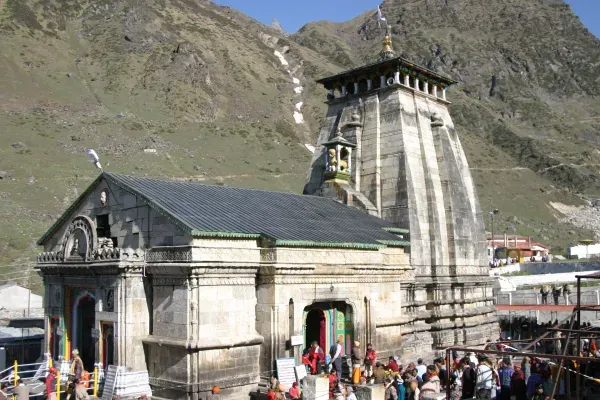
Shankara's final journey leads him to Kedarnath in the high Himalayas — a sacred Shiva shrine in the Garhwal mountains, at 3,583 metres above sea level, accessible only in summer before the snows close the passes. He is approximately thirty-two years old. The tradition says he walked into the inner sanctum of the Kedarnath temple and simply did not return — his body was never found. He had merged with Shiva, whom he had worshipped, hymned, and identified with the Absolute throughout his life. The teaching was complete.
Key Figures
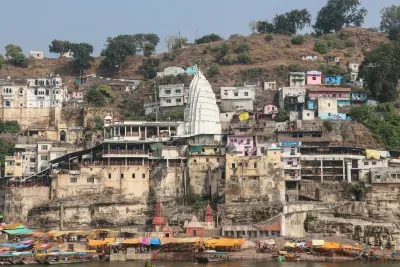
Govindapada
Govinda Bhagavatpada meditated in a cave at Omkareshvara on the Narmada, transmitting an Advaita lineage that traced back through Gaudapada to the Mandukya Upanishad. He was not a prolific author — perhaps primarily an oral teacher — but he recognized in the young Shankara an aptitude so extraordinary that he told him: the work I could not finish, you will. He gave Shankara formal initiation into the Dasanami monastic order and sent him to Kashi to write. The entire edifice of classical Advaita Vedanta rests on that one decision made in a cave above a river.
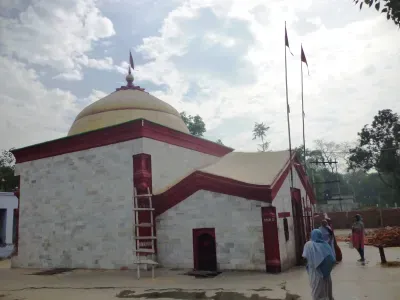
Mandana Mishra
Mandana Mishra was an important philosopher associated with works including the Brahmasiddhi and Vidhiviveka. Later debate narratives identify him with Shankara’s disciple Suresvara, but that identification remains disputed in scholarship. The garland contest belongs to those narratives, not secure contemporary testimony.
The Legacy of Shankara
Adi Shankaracharya lived for approximately thirty-two years and reshaped an entire civilization. He found Indian philosophical thought fragmented among dozens of rival schools — Mimamsa, Samkhya, Vaisheshika, Nyaya, and multiple Buddhist traditions — and left it unified around a single, radical idea: Brahman alone is real; the world we perceive is not ultimately real; and the individual self is Brahman itself, not other. This is Advaita Vedanta — non-dualism — and it became the dominant school of Hindu philosophy, a position it still holds.
His philosophical influence did not end in the medieval period. Swami Vivekananda brought Advaita Vedanta to the West at the Parliament of World Religions in Chicago in 1893, identifying it as the philosophical heart of Hinduism. Ramana Maharshi, the 20th-century sage of Tiruvannamalai, taught a direct path to self-inquiry that was unambiguously Advaitic. Schopenhauer, reading Anquetil-Duperron's Latin translation of the Upanishads, found in them the same non-dualist insight he was reaching for through Kant. The philosopher who died barefoot in the Himalayas at thirty-two continues to speak.
Read his story in his own words — the river, the cave, the city, the debate, the mathas, the mother, the mountain — in the first-person ePub.
Get the Full Book
Read the story of Shankara — 8 chapters of historical narrative.
Dramatised first-person narrative; not an autobiography.