
Ibn Sina
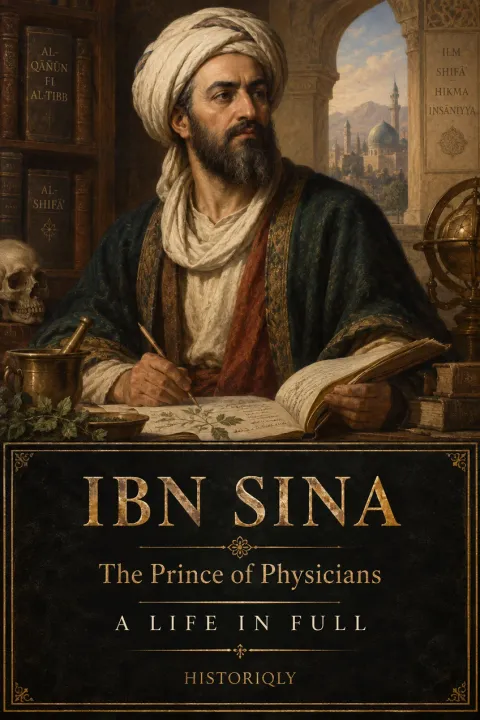
The Prince of Physicians
Get the full EPUB
Drop your email and the EPUB downloads straight to your device. We'll also ping you when the next chronicle lands — unsubscribe any time.
Your email is already on file — enjoy the read.
Download the EPUBIbn Sina’s Canon of Medicine organised medical learning into five books and became influential in Arabic and Latin medical traditions. Its discussion of testing drugs belongs to Book Two. The conditions he proposed should be read within medieval medicine, rather than called modern controlled clinical trials. The physician and philosopher wrote while moving among courts and serving rulers in several capacities. His life is partly recoverable through the autobiographical account continued by his pupil al-Juzjani.
“Medicine is the science by which we learn the various states of the human body, in health and when not in health.”
c. 980–1037 CE
Born in Afshana, near Bukhara (in present-day Uzbekistan), around 980 CE. Died in Hamadan, western Persia, in June 1037 CE. He lived through the collapse of the Samanid dynasty, the rise of the Ghaznavids, and the fragmentation of the Persian plateau into rival principalities — and somehow, through all of it, kept writing.
760
The Canon of Medicine catalogued 760 medicinal substances, describing their properties, preparation, and application. Each entry documented the drug's degree of heat, cold, moisture, and dryness — following Galenic humoral theory — alongside empirical observations of its effects. The drug index alone made the Canon a standard pharmaceutical reference for centuries.
5
The <em>Qānūn fī al-Ṭibb</em> was organised into five books: general principles of medicine; simple drugs; diseases organised by organ system from head to toe; conditions affecting the whole body; and compound medications. This systematic structure — from theory to practice to pharmacology — became the template for how medicine was taught and organised in both the Islamic world and medieval Europe.
6+
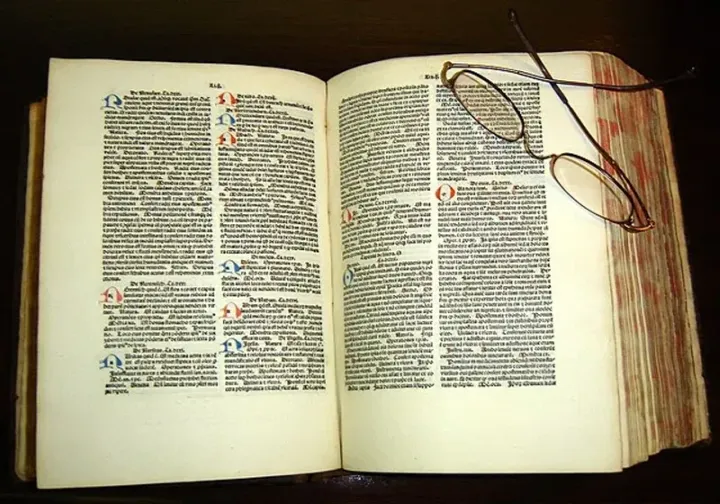
The Canon was translated into Latin by Gerard of Cremona in the twelfth century, printed at least sixty times between 1500 and 1674, and remained a required text at many European medical schools well into the seventeenth century. At the University of Montpellier it was still being taught in 1650. Few books in any discipline have maintained authority for as long.
Author of the Canon of Medicine, philosopher of the Islamic Golden Age, synthesiser of Greek and Islamic medical tradition
Defining Events
The Canon of Medicine
The Qānūn fī al-Ṭibb was the most ambitious medical synthesis in history. Where al-Razi had compiled empirical observations in the encyclopedic but unsystematic Hawi, Ibn Sina created a logical architecture: a framework in which every disease, every drug, every treatment had its place. Book One laid out the principles of medicine — the elements, the humours, the temperaments, the anatomy of organs. Books Two through Five moved systematically from simple drugs to compound remedies, from diseases of the head to diseases of the body as a whole. The Canon did not merely compile — it organised, argued, and synthesised. When it reached Latin Europe in the twelfth century, physicians had, for the first time, a single coherent system of medicine that could be taught and examined.
The Prodigy of Bukhara
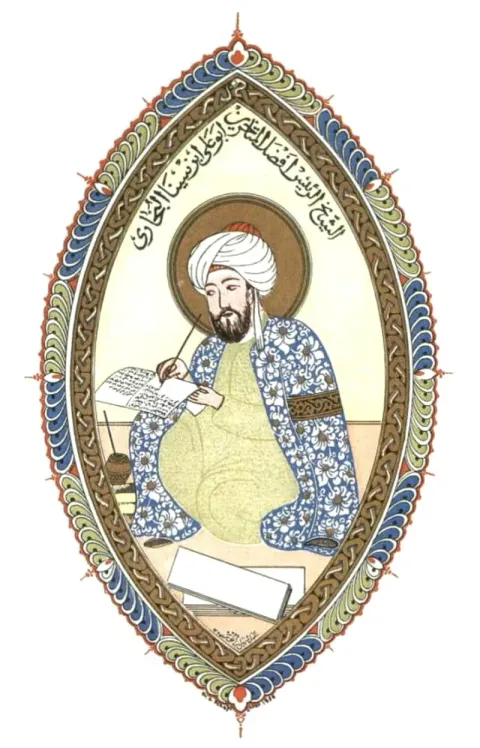
Ibn Sina was, by any standard, a phenomenon. He had memorised the Quran by the age of ten. By sixteen he had mastered logic, natural science, and mathematics. By seventeen he had studied medicine — which he later called 'not a difficult science' — and had cured Nuh ibn Mansur, the Samanid emir of Bukhara, of an illness that had baffled the court physicians. His reward was access to the royal library: a vast collection of texts in philosophy, science, and medicine. Ibn Sina read everything in it. He later wrote that by the age of eighteen he had mastered all the sciences of his day — not as a boast, but as a straightforward account of what had happened. At twenty-one he wrote his first philosophical encyclopedia. He would never stop writing.
The Book of Healing
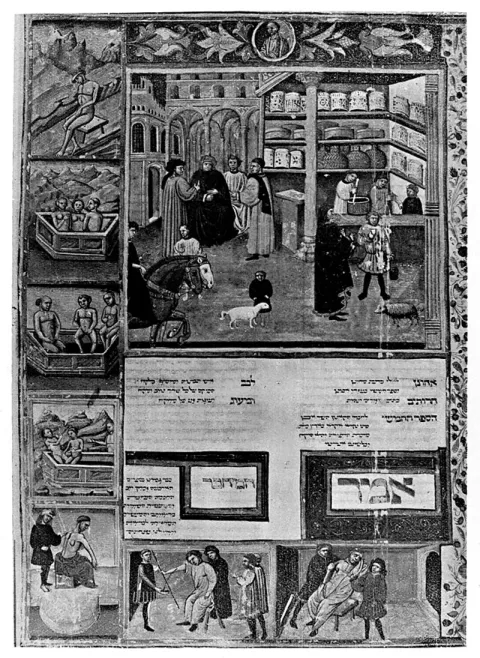
Alongside the Canon of Medicine, Ibn Sina composed the Kitāb al-Shifāʾ — the Book of Healing. Despite its title, it was not a medical work but a philosophical encyclopedia covering logic, the natural sciences, mathematics, and metaphysics. In scope it was the most ambitious work of systematic philosophy since Aristotle, and in some respects surpassed it: Ibn Sina's treatment of the soul, of emanation, and of the relationship between essence and existence would define Islamic philosophy for generations and reappear — transformed — in the Latin Scholasticism of Aquinas and Duns Scotus. The Shifa also contained, in its section on music, one of the most sophisticated discussions of musical theory in the medieval world. He wrote much of it on horseback and in prison.
Timeline
Born near Bukhara
Abū ʿAlī al-Ḥusayn ibn ʿAbd Allāh ibn Sīnā is born in Afshana, a small village near Bukhara in the Samanid province of Transoxiana (present-day Uzbekistan). His father was an administrator for the Samanid court. Bukhara was then one of the great cities of the Islamic world — capital of the Samanid dynasty, a centre of Persian culture and learning. The young Ibn Sina grows up in an environment of books, scholars, and Persian literary culture.
Prodigy in Bukhara
By his own account, Ibn Sina had memorised the Quran and a great deal of Arabic poetry by the age of ten. His father brought teachers to the house — a grocer who taught arithmetic, a philosopher named al-Natili who introduced him to logic. Ibn Sina quickly outpaced both. He began studying medicine at sixteen, finding it 'not difficult' — distinguishing himself by treating patients while still a teenager. He studied Aristotle's Metaphysics forty times before understanding it, and credits al-Farabi's commentary with finally unlocking its meaning.
Cures the Samanid Emir
Nuh ibn Mansur, the Samanid emir of Bukhara, falls ill with a condition that defeats his court physicians. Ibn Sina is summoned and succeeds where the others failed. His reward is access to the royal library of Bukhara — a collection of exceptional depth that contains texts Ibn Sina will later say he never saw again anywhere. He reads through it systematically. The library is later destroyed, and he is sometimes accused of setting the fire himself to secure a monopoly on the knowledge — a charge he denies.
Fall of the Samanids
Bukhara falls to the Qarakhanids in 999. Ibn Sina’s later autobiographical sequence places his father’s death after he was twenty-one; the events should not be compressed into a single immediate flight in 999. His subsequent career took him through several courts.
Flight from Mahmud of Ghazni
Ibn Sina moves through several courts and towns as political conditions change. His autobiographical account records travel and patronage; later tales of Mahmud pursuing him through distributed portraits are less secure. Medicine and writing continue through these unsettled years.
The Book of Healing
Settled for a period under the patronage of the Buyid ruler in Hamadan, Ibn Sina begins composing the Kitāb al-Shifāʾ — the Book of Healing — a philosophical encyclopedia covering logic, mathematics, natural science, and metaphysics. It is the most comprehensive philosophical work since Aristotle. He writes with extraordinary speed — reportedly fifty pages a night — dictating to students and scribes between sessions of court service. He continues to practise medicine daily.
Completion of the Canon
The Qānūn fī al-Ṭibb — the Canon of Medicine — is completed. It runs to five books and nearly a million words, cataloguing 760 drugs, systematising all known medical knowledge, and proposing explicit methods for testing the efficacy of drugs in clinical practice. It is the most comprehensive medical work in any language. Ibn Sina will continue revising and expanding it until his death.
Imprisonment and Escape
Political conflict leads to imprisonment at Fardajan. After about four months he is released in the aftermath of Ala al-Dawla’s campaign. His later departure from Hamadan in Sufi disguise is a separate episode; he travels with his brother, al-Juzjani and two enslaved attendants to Isfahan.
Isfahan and Final Years
Under ʿAlā al-Dawla in Isfahan, Ibn Sina enters his most productive late period — refining the Canon, working on music theory and astronomical observations, writing shorter philosophical treatises including the Ishārāt wa al-Tanbīhāt (Remarks and Admonitions), his final and most personal philosophical work. He accompanies the ruler on military campaigns across Persia. On one campaign to Hamadan, he falls severely ill — possibly with colic — and dies in June 1037, around the age of fifty-seven. He is buried in Hamadan, where his mausoleum still stands.
Key Figures
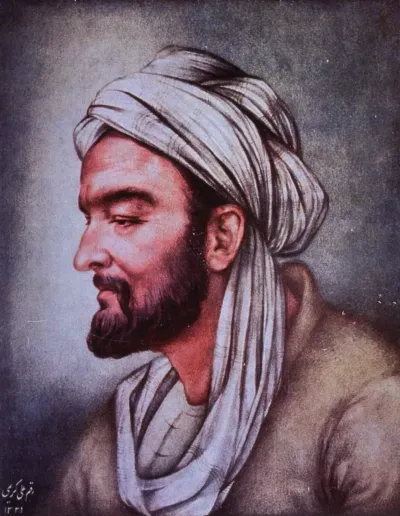
Al-Razi (Rhazes)
Muhammad ibn Zakariyyā al-Rāzī (c. 854–925 CE) was the greatest empirical physician of the generation before Ibn Sina. His vast Kitāb al-Ḥāwī — The Comprehensive Book — compiled clinical observations on an unmatched scale and first distinguished smallpox from measles. Ibn Sina knew and admired al-Razi's work, incorporating it into the Canon while imposing the systematic architecture that the Hawi lacked. The two figures together — al-Razi's empirical richness, Ibn Sina's systematic framework — gave medieval medicine its foundation.
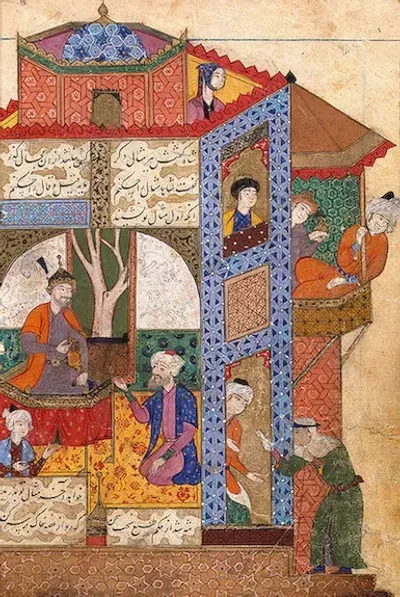
Mahmud of Ghazni
Mahmud of Ghazni (971–1030 CE) was the most powerful ruler of the eastern Islamic world — a great patron of Persian poetry (Firdausi wrote the Shahnameh at his court) and a ferocious military expansionist. He demanded that Ibn Sina come to his court. Ibn Sina refused repeatedly. Mahmud distributed the scholar's portrait across Central Asia and maintained agents watching for him. Ibn Sina spent years in flight partly because of Mahmud's pursuit, moving westward into territories beyond his reach. The hostility was partly ideological: Mahmud was a Sunni of strict Hanafi orthodoxy; Ibn Sina's rationalist philosophy made him suspect.
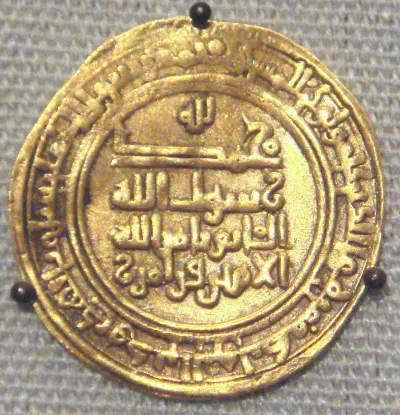
ʿAlā al-Dawla
ʿAlā al-Dawla Muhammad ibn Rustam Dushmanziyar, the Kakuyid ruler of Isfahan, provided Ibn Sina with the most stable and supportive patronage of his career. Under his protection from around 1023 CE until his death in 1037, Ibn Sina refined the Canon, completed the Shifa, wrote astronomical observations, composed treatises on music and language, and accompanied the ruler on campaigns. ʿAlā al-Dawla held a philosophical discussion group that Ibn Sina attended weekly. He treated the scholar as a companion and intellectual equal rather than merely a court physician.
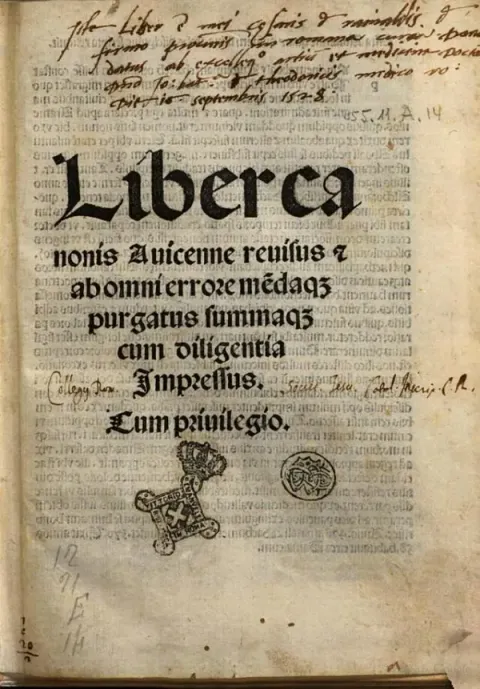
The Legacy of Ibn Sina
The Canon of Medicine was translated into Latin by Gerard of Cremona in the twelfth century. It was printed at least sixty times between 1500 and 1674. At the University of Louvain it was used until 1909. At the University of Montpellier, one of the great medieval medical schools, it remained a required text in the seventeenth century. In the Islamic world it never ceased to be a standard reference. Avicenna's portrait still hangs at the Faculty of Medicine of the University of Paris.
The Book of Healing's influence on European Scholasticism — on Albertus Magnus, on Thomas Aquinas, on Duns Scotus — was profound enough that a tradition of 'Latin Avicennism' bears his name. His argument for the existence of the soul through the 'floating man' thought experiment (a person created in the air with no sensory input who still knows that they exist) anticipated Descartes by six hundred years.
He was also, in the ordinary sense, a physician who saw patients, compounded drugs, supervised hospital wards, and trained students in the clinical care of the sick. He did this while serving as vizier to unstable courts, while imprisoned in mountain fortresses, while riding on military campaigns across Persia.
Read the Canon in his own words — the first-person ePub follows Ibn Sina from the royal library of Bukhara to the fugitive roads of Persia to the court of Isfahan, through the writing of the books that shaped medicine and philosophy for half a millennium.
Get the Full Book
Read the story of Ibn Sina — 8 chapters of historical narrative.
Dramatised first-person narrative; not an autobiography.