
Pachacuti
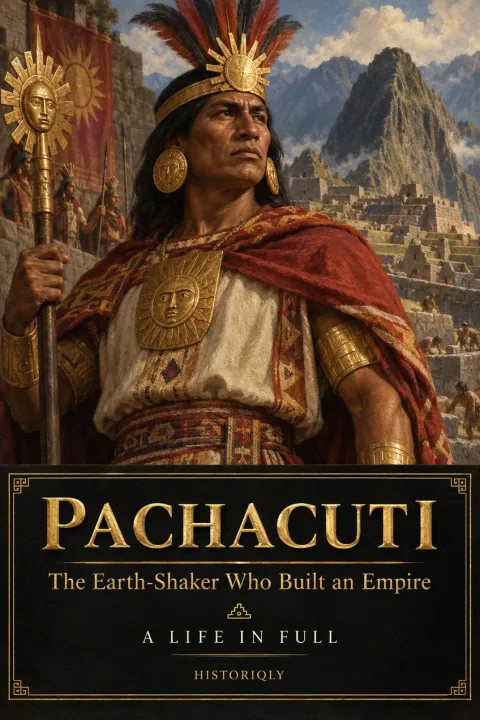
The Earth-Shaker Who Built an Empire
Get the full EPUB
Drop your email and the EPUB downloads straight to your device. We'll also ping you when the next chronicle lands — unsubscribe any time.
Your email is already on file — enjoy the read.
Download the EPUBIn 1438, a young Inca prince named Cusi Yupanqui stood alone in the sacred precinct of Cusco while his father and elder brother fled into the hills. The Chanka confederation — the ancient enemies of the Inca — were marching on the city with an army that outnumbered every warrior he could muster. That night, he prayed to the creator god Viracocha, and the stones of the battlefield are said to have risen and become warriors in his defence. Whether or not the earth literally moved that night, something extraordinary happened: Cusi Yupanqui defeated the Chanka, deposed his own father, and renamed himself Pachacuti — "The Reversal of the World." Then he set about building an empire.
“I was born as a lily in the garden, and like the lily I grew — as my age advanced I became old, and had to die, and so I withered and died.”
c. 1418–1471 CE
Born in Cusco as the younger son of the 8th Sapa Inca Viracocha, Cusi Yupanqui was not expected to rule. He died in 1471 after a reign of thirty-three years that transformed a valley chiefdom into the largest empire in the pre-Columbian Americas.
4,000 km
When Pachacuti took the throne in 1438, the Inca controlled roughly 40 kilometres around Cusco. By his death in 1471, Tawantinsuyu stretched four thousand kilometres from what is now southern Colombia to central Chile — the largest empire on earth at the time.
40,000 km
The Qhapaq Ñan — the Royal Road — was expanded under Pachacuti's direction into a subcontinental network of over forty thousand kilometres, connecting every corner of Tawantinsuyu and enabling the fastest communication system in the Americas.
Fifteenth century
Machu Picchu is associated with Pachacuti’s royal estate. Occupation dated by radiocarbon to around 1420–1532 begins earlier than the conventional chronology of his reign, leaving the foundation date open to reassessment.
9th Sapa Inca, founder of the Inca Empire, builder of Machu Picchu, architect of Tawantinsuyu
Defining Events
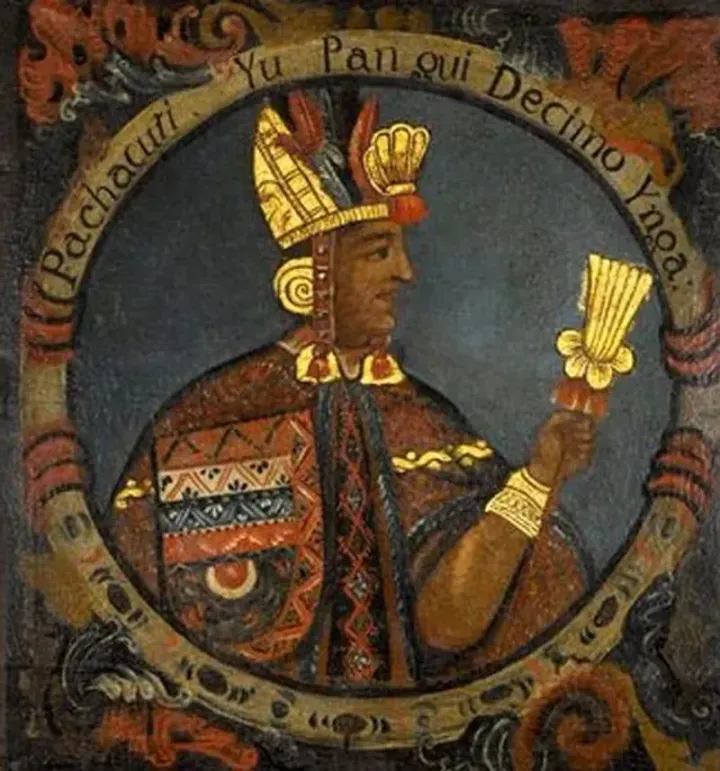
The Defeat of the Chanka
Cusi Yupanqui remains to defend Cusco in the chronicles’ accounts. Victory over the Chankas becomes the central story of his rise. Versions differ over commanders, divine aid and the sequence of fighting; their shared emphasis is the transformation of the prince’s authority.
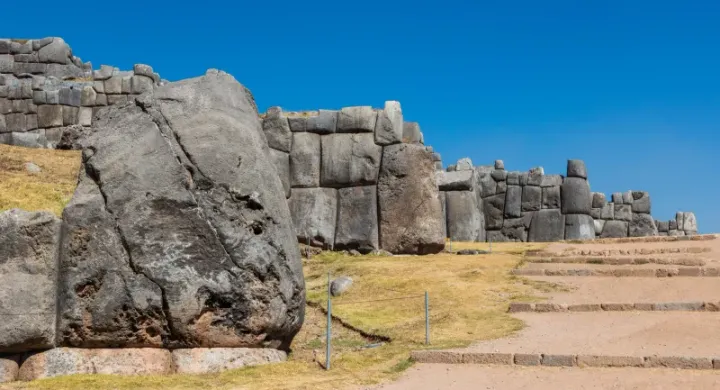
The Rebuilding of Cusco
Pachacuti did not merely conquer — he created. After taking the throne, he drained the swamps of the Cusco valley, laid out the city in the shape of a puma, and reconstructed the Qorikancha (Temple of the Sun) with walls plated in gold. He built Sacsayhuamán on the heights above the city using stones weighing up to 125 tonnes — Cieza de León recorded that twenty thousand workers were ordered from the provinces, four thousand to cut stone and six thousand to haul it. He established the mit'a labour system, the quipu record-keeping apparatus, and the ceque sacred landscape that organized religion, governance, and calendar into a single integrated architecture.
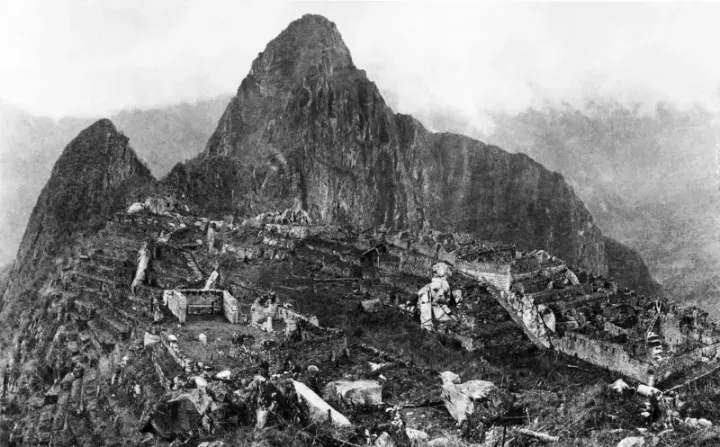
Machu Picchu
Machu Picchu stands above the Urubamba River and is associated with Pachacuti’s estate. Its terraces, drainage and stone architecture reflect extensive skilled labour. Radiocarbon dates around 1420–1532 challenge the conventional foundation chronology; the site was known locally before Hiram Bingham’s visit in 1911.
Timeline
Born as Cusi Yupanqui
Born in Cusco as the son of Viracocha Inca, the 8th Sapa Inca, and one of his secondary queens. As a younger son, Cusi Yupanqui was not in the line of succession — his elder brother Inca Urco had been designated crown prince. His birth name, Cusi Yupanqui, meant 'Honourable Fortunate One.' Few at court imagined he would ever rule.
The Chanka Threat Builds
The Chanka attack forms the decisive crisis in accounts of Pachacuti’s rise. The chronicles preserve different versions; in Sarmiento’s account Asto Huaraca and Tomay Huaraca command the attackers, who carry sacred ancestral images.
Viracocha Flees — Cusi Yupanqui Stands
The chronicles describe Viracocha Inca and Urco withdrawing as the Chankas threaten Cusco. Cusi Yupanqui stays to organise resistance. Narratives of divine aid accompany his victory; Anco Huallu’s later escape belongs to a different campaign.
The Battle of Cusco — Pururaucas
In the decisive engagement, Cusi Yupanqui's forces met the Chanka on the field. The battle's most famous detail — recorded by multiple Spanish-era chroniclers — is that stones on the battlefield rose up and became warriors, called pururaucas. Whether miraculous or legendary embellishment, the account became central to Pachacuti's founding mythology. He personally killed or captured Uscovilca, seized the sacred effigy, and routed the Chanka army. The victory was total.
Coronation and the Name Pachacuti
After the victory, Cusi Yupanqui demanded recognition from his father. Viracocha refused at first, attempting to preserve his heir Urco. Cusi Yupanqui rejected this. He assumed the throne — reportedly after Urco was killed in the ensuing struggle, though the sources are contested — and renamed himself Pachacuti Inca Yupanqui: 'The Reversal of the World, Honourable Lord.' The name was deliberate. In Andean cosmology, a pachakuti was a cataclysmic turning of the world — the end of one age and the beginning of another. He was declaring himself that turning.
Rebuilding Cusco
Pachacuti immediately began the total reconstruction of Cusco. He drained the swamp between two rivers, reorganised the city in the shape of a puma (the sacred Inca symbol of power), built grand ceremonial plazas — the Huacaypata and the Aucaypata — and established separate districts for nobles, priests, and craftsmen. The Qorikancha, the Temple of the Sun, was rebuilt with walls lined in gold. He resettled the Cusco region's previous inhabitants to distant provinces and repopulated the valley with loyal subjects — a practice called mitimae.
Northern Campaigns — and a Brother's Execution
In Sarmiento’s account, Capac Yupanqui exceeds a northern campaign boundary at Yana Mayu in Huayllas. Anco Huallu’s Chankas escape after learning of orders to kill them. On the return, Capac and his brother Huayna Yupanqui are killed at Limatambo. The narrative exposes the violence and insecurity within imperial command.
Southern Conquest — Collasuyu
Pachacuti turned south, conquering the powerful Colla and Lupaqa peoples of the Lake Titicaca basin — the high-altitude altiplano that today straddles Peru and Bolivia. These were some of the most populous regions in the Andes. The Lake Titicaca basin's rich agricultural and herding lands became the core of Collasuyu, the largest of the empire's four quarters. The conquest extended Tawantinsuyu across the entire Andean world.
Machu Picchu Commissioned
Machu Picchu is traditionally associated with Pachacuti’s estate. Its precise construction sequence and his personal design decisions are not recorded. Radiocarbon evidence for occupation from around 1420 makes a fixed commissioning date around 1450 problematic.
Sacsayhuamán and the Ceque System
On the heights north of Cusco, Pachacuti began construction of Sacsayhuamán — the vast ceremonial fortress whose zigzagging walls of megalithic stone could be seen from miles away. Cieza de León recorded that twenty thousand workers laboured there at any one time. Simultaneously, Pachacuti codified the ceque system: 41 sacred radial lines emanating from the Qorikancha, each lined with huacas (sacred shrines), organising religious duties, the ritual calendar, and the social order of Cusco into a single integrated landscape.
Tupac Named Co-Regent
Pachacuti removed his eldest son Amaru Yupanqui as heir — Amaru was a gifted engineer and devoted to peaceful projects, but lacked the military temperament Pachacuti believed an empire required. He named his second son Tupac Inca Yupanqui as co-regent and military commander. It was an extraordinarily clear-eyed decision: Tupac would prove to be one of the greatest military leaders in Andean history.
Tupac's Campaigns
Under Pachacuti's direction and authority, Tupac Inca Yupanqui led campaigns that extended the empire into modern Ecuador, pushing into the Quito basin and the northern Andes. The Chimú Empire — the greatest coastal civilisation of the Americas, centred at Chan Chan — fell to Tupac around 1470. Pachacuti, now in his late fifties, remained in Cusco directing, planning, and managing the vast administrative apparatus he had built.
Death and Mummification
Pachacuti died in 1471 after a reign of thirty-three years. The entire empire mourned for one year. According to Pedro Sarmiento de Gamboa — who compiled his chronicle in 1572 from testimony of surviving Inca nobles — Pachacuti composed a poem on his deathbed, comparing himself to a lily that grew, aged, and withered. His body was mummified and became a mallki (royal mummy), consulted in political crises, dressed, fed, and carried in ceremonies by his panaka (royal descent group) for decades afterward.
Key Figures
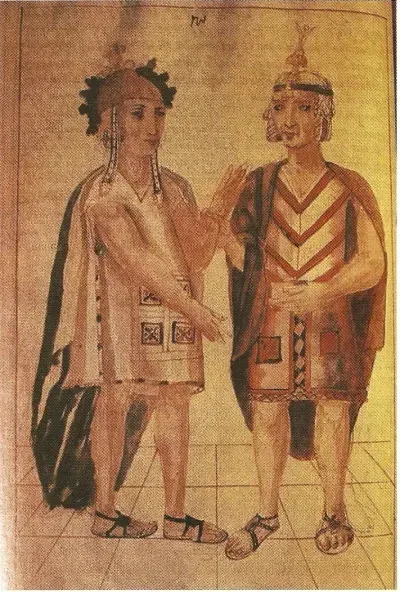
Tupac Inca Yupanqui
The second son Pachacuti chose over his elder brother Amaru Yupanqui — a decision that defined the empire's next generation. Tupac was named co-regent around 1463 and immediately demonstrated why his father had chosen him: he conquered the Quito basin, extended the empire into modern Ecuador and Colombia, and brought down the Chimú Empire of Chan Chan around 1470. After Pachacuti's death he ruled as the 10th Sapa Inca from 1471 to 1493, expanding the empire further into Chile and Argentina. In many respects he was the greatest of all the Inca military commanders — but the administrative architecture he ruled was entirely his father's creation.
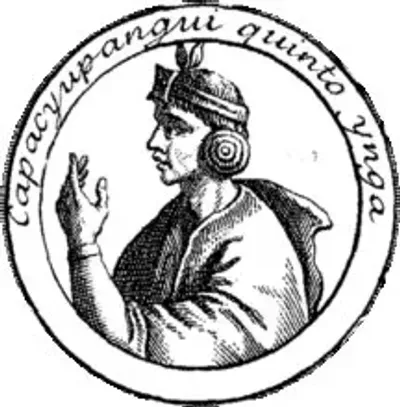
Capac Yupanqui
Capac Yupanqui led northern campaigns under his brother Pachacuti. Sarmiento connects his downfall with disobedience, the escape of Chanka troops and the ruler’s suspicions. His execution, alongside Huayna Yupanqui at Limatambo, reveals conflict within the ruling family; the sources do not give secure access to Pachacuti’s private motives.
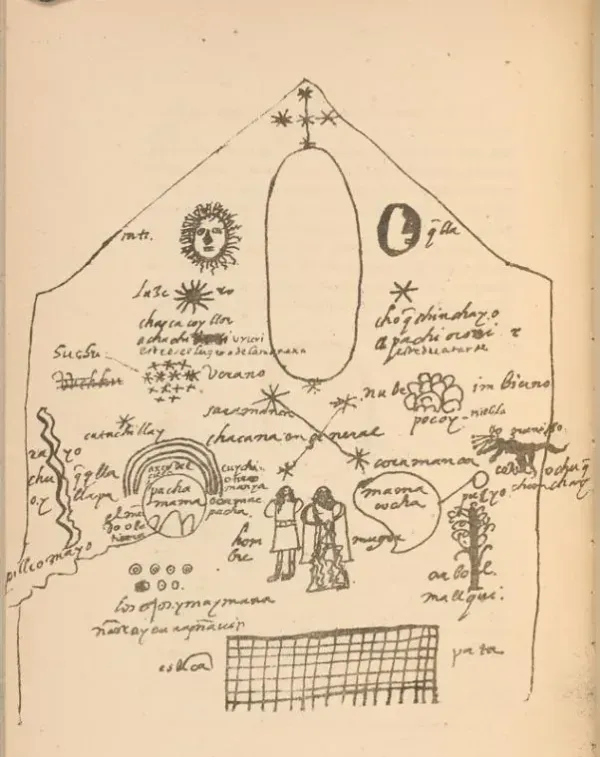
The Legacy of Pachacuti
Pachacuti died in 1471, but his empire did not die with him. Tawantinsuyu — the Four Quarters of the World, the administrative and spiritual architecture he had designed — functioned for another sixty years until Francisco Pizarro captured the Sapa Inca Atahualpa at Cajamarca in 1532. What the Spanish encountered was not some primitive chiefdom but the most sophisticated political system in the Americas: a decimal bureaucracy, a forty-thousand-kilometre road network, a state religion woven into the geography of the Andes, and an economy that had never needed money because it ran on something more powerful — the labour and loyalty of ten million people organised by a single vision.
Historian John Rowe, the twentieth century's greatest authority on the Inca, called Pachacuti "the greatest man produced by the aboriginal civilisations of the Americas." The statue in Cusco's central plaza today, the UNESCO World Heritage Site on the mountain ridge above the Urubamba River, the Quechua words that still name the hours of the day in the Andes — all are his. Read his story in his own words in the first-person ePub.
Get the Full Book
Read the story of Pachacuti — 8 chapters of historical narrative.
Dramatised first-person narrative; not an autobiography.